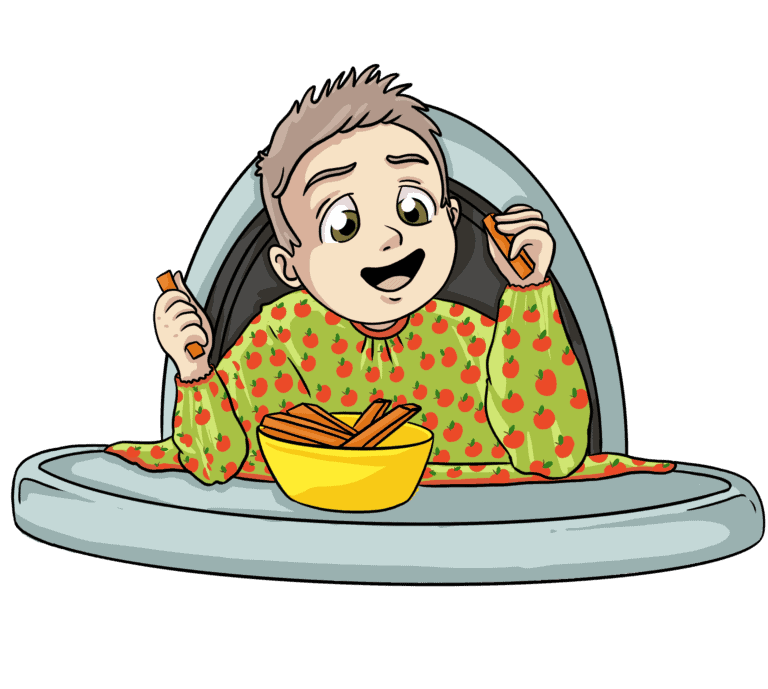
You had imagined a quiet meal.
Baby is settled. The meal is ready. And three minutes later, he pushes his plate away, grumbles, throws a piece on the floor, demands to be held or starts to cry outright.
On your end, the tension is also starting to rise.
"But you haven't eaten anything yet..."
"I prepared all this for nothing."
"Why are all meals becoming so complicated lately?"
Mealtimes with a baby aren't just about food and quantities. Emotions also have their place at the table.
Baby's, obviously. But ours too.
And when they start to take up a lot of space, a meal that was supposed to last a few minutes can quickly turn into a tense moment for the whole family.
So why does this happen? And above all, how can we regain some peace of mind?

A meal requires a lot from the baby
Eating seems simple to us because we've always done it.
For babies, it's much more complex.
During a meal, he has to manage both:
his hunger;
new textures;
new flavors;
food handling;
its coordination;
the sensations in her mouth;
the noise and environment around him;
sometimes there is frustration when he cannot do what he wants.
Add to that a bad night's sleep, teething, a busy day, or simply extreme fatigue…
And the plate can suddenly become the problem too far.
A complicated meal does not automatically mean that the baby doesn't like what you've prepared or that he's "making a fuss".
Sometimes, he is simply no longer available enough to eat peacefully.
This is particularly common at the end of the day. If mealtimes become especially difficult in the evening, our article "Baby is too tired to eat in the evening: what to do?" will help you determine if fatigue is a factor.
Crying, anger, frustration: what is baby trying to tell us?
A baby cannot yet come to the table and explain to us:
"I had a long day today, I'm tired, this piece is slipping through my fingers and it's really frustrating me." 😅
He communicates differently.
Depending on his age and situation, he may:
cry ;
to complain;
repel food;
throw ;
to arch one's back;
wanting to get out of his chair;
demand arms;
refuse food;
try to pick up your spoon;
to get angry when someone intervenes.
The goal is not to decode every behavior as if there were a secret baby dictionary.
But one might ask:
What could make this meal difficult today?

Sometimes, baby just wants to do it alone
Frustration can also stem from a need for autonomy.
You try to give him a spoon, he pushes it away.
You put food back in his hand, he gets upset.
You want to help him grab something… and clearly your intervention wasn't part of the plan. 😅
As the baby develops, it gradually wants to participate more.
Giving him a little space can sometimes be enough to completely change the atmosphere of the meal.
We explain precisely why in the article Why let baby eat alone during meals?
Autonomy obviously does not mean a lack of support.
We remain present, we provide security, we help when he really needs it… but without necessarily doing it for him immediately.
And sometimes… he's simply not hungry anymore
This is probably one of the most frequent causes of tension.
We look at the plate and we think:
"He hardly ate anything."
The baby, on the other hand, might simply be thinking:
"I'm finished."
His appetite can vary enormously from one meal to the next.
One day he eats with enthusiasm. The next day, three bites are enough for him.
When a baby slows down, turns their head away, pushes food away or completely loses interest in their meal, it may be a sign that they are full.
Insisting at that point can quickly turn a normal end to a meal into a moment of conflict.
If small quantities worry you, also check out our article Baby refuses to eat: normal or worrying?
Our own emotions also come to the table
This is probably the part that gets talked about the least. We prepare the meals. We think about balance. We do the shopping. We cook.
And when everything ends up smashed on the shelf or thrown to the floor after two bites, it's human to feel frustrated.
Add to that this very parental little worry:
"Is he eating enough?"
And without really realizing it, we start wanting to control the meal more.
"Just one more bite."
"At least try it."
"You haven't eaten anything."
We bring the food closer together.
We propose something else.
Then something else entirely.
We're trying to distract them.
And mealtimes gradually become a goal to be achieved rather than a time when baby can listen to their feelings.

The more you want him to eat, the more the pressure can increase
It's a strange trap. Baby isn't eating much. We're worried. So we're trying harder to get him to eat.
Baby senses that mealtimes are becoming more insistent or tense. He resists more. We worry even more.
And the cycle begins.
The goal is obviously not to become perfectly zen in front of every food item thrown across the kitchen.
But sometimes, simply becoming aware of this dynamic is enough to break it.
Before offering an extra bite, one might ask:
"Is the baby showing me that he still wants to eat... or is it me who would like him to eat more?"

Responsive food: observe rather than convince
One interesting approach is to pay attention to the baby's signals.
The parent obviously retains their role.
He chooses what is offered, ensures that the food is suitable and safe, and creates a setting for the meal.
Baby, on the other hand, can gradually listen to his sensations and decide how much he wants to eat.
This approach does not mean that the baby is only allowed to choose their favorite foods or that they decide on the entire family organization.
It mainly means that we avoid deciding for him when he has eaten enough.

What to do when the tension starts to rise?
No need to revolutionize your entire organization.
A few simple actions can already help.
Check the context
Before concluding that baby "doesn't want to eat anymore", look at what is happening around mealtimes.
Is he hungry? Did he drink his milk just before? Is he tired? Does he have a toothache? Is he sick?
Is there a lot of noise or distractions around him?
Does the meal regularly come at the time when the baby is reaching the end of their capacity?
Sometimes, the problem isn't what's on the plate at all.

Simplify the plate
A very full plate can also be unnecessary.
You can start with a few foods or pieces and then add more later.
This allows the baby to focus more easily on what's in front of them and can also avoid that strange parental feeling of having prepared a whole feast only to see the baby eat exactly half a pancake. 😅
Do not systematically replace everything that is rejected
Baby refuses his meal.
He was then offered a second course.
Then his favorite fruit.
Then something else.
Over time, this can make mealtimes even more complicated.
This does not mean that we should never adapt.
If the baby is sick, if the format is not suitable, or if you notice a real problem with what is offered, of course we will adjust.
But a one-off refusal does not systematically need to be "repaired".

Acknowledge the emotion without immediately trying to make them eat
Is the baby frustrated?
You can recognize him.
"You're frustrated; this piece is hard to catch."
"I can see you don't want it anymore."
"You look tired."
No need for long speeches.
Putting a few words to what he is experiencing can simply allow us to remain in a supportive role rather than directly entering into a power struggle over food.
And what happens when he throws away all his food?
This is probably one of the most effective ways to raise our blood pressure in seconds. 😅
However, throwing can have several meanings.
The baby may be experimenting, still lacking precision, seeking a reaction, having finished their meal, or expressing their need for autonomy.
Before you start a game of ping-pong where you pick up each piece only to have it immediately thrown back on the ground, try to observe the context.
Our article "Why does baby throw food on the floor?" helps to understand the different reasons behind this behavior.
A beloved food can suddenly become public enemy number one
Yesterday, the baby was still asking for courgettes.
Today, he looks at them as if you had committed a personal betrayal.
Again, there's no need to panic.
Preferences change.
A refusal may be temporary and depend on fatigue, development, texture, or simply the mood of the day.
Continue to make proposals regularly without pressure.
We develop this topic in Why does baby love a food... then refuse it?
What if the real problem was the mental load surrounding meals?
Sometimes it's not just the baby who arrives at the table with a dead battery.
Us too. Find an idea. Go shopping. Prepare. Adapt. Clean up.
Then start again tomorrow.
When every meal requires a huge amount of energy even before the baby is settled, the slightest refusal can become much harder to accept.
In times like these, simplifying is sometimes better than trying to do things perfectly.
Reusing a known recipe, cooking in larger quantities, freezing some preparations or relying on a pre-planned menu can really ease the pressure.
If it's mainly a lack of ideas that's exhausting you, thesubscription BLW Baby gives you access to the platform's recipes and a new menu every week to avoid starting from scratch every day.

Try watching several meals rather than just one
A difficult dinner can sometimes take up a lot of space in our minds.
However, it can be worthwhile to take a step back.
How are the other meals?
Does the difficulty only appear in the evening?
With all the textures?
Only when certain foods are offered?
At home but not at daycare?
When baby is very tired?
If mealtimes become regularly tense, you can even make a note for a few days:
mealtime;
the last milk or meal;
the duration of the nap;
what was proposed;
baby's behavior;
the moments when the tension arose.
Not to turn meals into a scientific study, but to possibly spot a pattern that we didn't see on a daily basis.

The meal can stop
Sometimes it's the simplest solution... and the one we most often forget.
If the baby clearly no longer wants to eat, becomes increasingly agitated and shows several signs indicating that he has finished, the meal can simply end.
There is no need to stay at the table for another twenty minutes hoping that one last bite will go down.
This does not mean that the meal is a failure.
Sometimes, stopping before everyone is exhausted is precisely what allows us to maintain a more peaceful relationship with meals.
The goal is not to have perfectly calm meals
A baby is still a baby.
He's going to laugh.
To complain.
To drop things.
Sometimes crying.
Sometimes I eat a lot, and sometimes almost nothing.
A serene meal is therefore not necessarily a silent meal with an empty plate and an immaculate chair.
It's more of a meal where everyone can gradually find their place, without every bite becoming a challenge.
When meals become really difficult on a daily basis
A difficult period can happen in any family.
But if you feel that every meal is becoming a source of stress, that you no longer know how to react, or that you have tried several things without being able to understand what the blockage is, an outside perspective can be helpful.
you BLW Baby coaching allows to discuss your specific situation, your questions and the difficulties encountered for 30 minutes in order to find adjustments adapted to your daily life.
BLW coaching obviously does not replace medical advice.
If your baby experiences pain when eating, significant difficulty chewing or swallowing, repeated vomiting, weight loss, a break in their growth curve, signs of dehydration, or any other symptom that worries you, talk to the healthcare professional who is treating your child.
What if you're still at the beginning of BLW ?
The first meals often generate many questions: formats, quantities, safety, balanced plates, allergens…
If you are looking for a general resource to help you progress step by step, the book BLW Baby – Baby learns to eat alone with BLW covers the basics of weaning, practical advice and recipes adapted to the different stages.
The idea is not to have all the answers from day one.
It's about having enough reference points to then be able to observe your baby, who will always remain the best indicator of what he needs at the table.

In summary
When a meal becomes complicated, it's not necessarily the food that's the problem.
Baby may be tired, frustrated, full, wanting more independence, or simply having a tougher day.
And we too can arrive at the meal with our fatigue, our worries and all the mental burden that accompanies it.
So before trying to force them to eat an extra bite, we can try to look at the situation as a whole.
What is the baby trying to show me?
And what is this meal causing in me?
Because the goal is not for every plate to be finished.
It's because, little by little, mealtimes remain a moment where baby can discover, learn, and listen to their senses… without the whole family dreading the next meal. 🤍