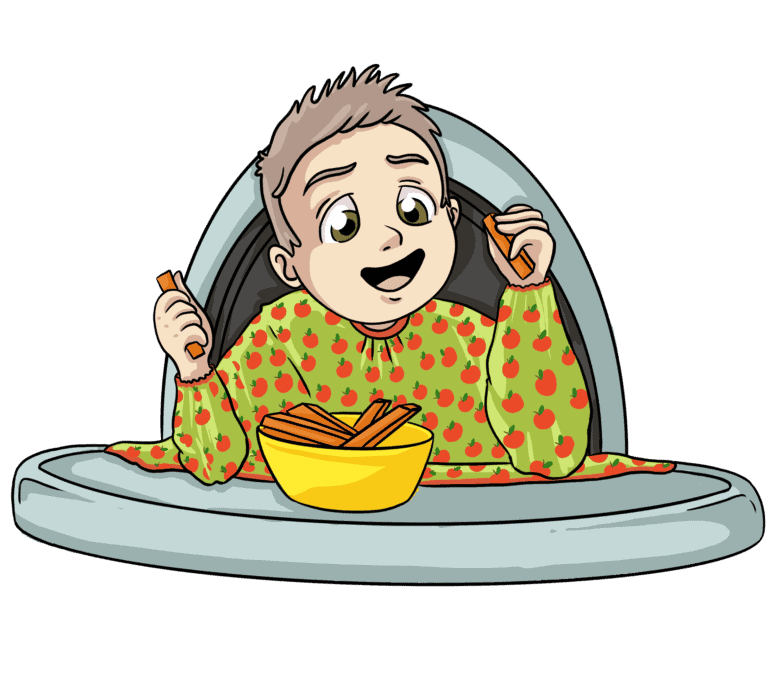
You place the meal in front of the baby.
He grabs a piece, squashes it between his fingers, tries to bring it to his mouth… misses. He tries again. Part of it ends up on the tablet, another part in his hair, and probably a little under the chair. 😅
And naturally, the desire to help comes quickly.
Should we let him do it alone, even when it would be so much faster to give it to him ourselves?
In BLW Baby-Led Weaning), autonomy is an integral part of mealtimes. But letting baby eat alone doesn't mean staying by without intervening no matter what.
The idea is rather to give him the opportunity to try, while providing him with the help he really needs.

Eating alone is something you learn
For us, grabbing food and bringing it to our mouths has become completely automatic.
For a baby, it's a succession of small skills to acquire.
He must learn to spot the food he wants to grab, extend his arm in the right direction, adjust his hand, grasp the piece, gauge his strength and then manage to bring it to his mouth.
In short, what looks like a simple piece of broccoli brought to the mouth is actually quite a little exercise in coordination.
It is by repeating these actions that the baby gradually gains precision and autonomy.
If you're just starting out with weaning, first make sure your baby has the necessary skills to begin. Find all the guidelines in our article " When to Start BLW ? The Signs Your Baby Is Ready."
Touching and crushing food is not "playing instead of eating"
When you see a baby crush a piece of food between their fingers or manipulate it for several seconds before eating it, you might get the impression that they are playing with their meal.
But at the beginning of weaning, exploring food is also part of learning.
Baby discovers that a banana is soft, that broccoli can fall apart between his fingers, or that a pancake does not react in the same way as a piece of avocado.
He discovers the texture, shape, temperature, smell, and resistance of each food.
Therefore, not everything has to end up immediately in the stomach for the meal to have been useful.

Why is autonomy important at the table?
Allowing baby to actively participate in their mealtime enables them to develop several skills at the same time.
Hand-eye coordination
Baby looks at a food item, tries to grab it and then bring it to his mouth.
At first, the journey is sometimes… creative. 😅
Through repeated attempts, his movements gradually become more precise.
Fine motor skills
At first, the baby usually grabs food with their whole hand.
Over time, his grip becomes more precise and he begins to use his fingers more, gradually developing the thumb-index finger pinch.
The food offered can then be adapted to its new capabilities. We detail these different steps in the article " When and how to adapt the pieces to BLW ?".
Sensory discovery
Even before tasting, babies learn a great deal by touching their food.
A sticky, wet, grainy or melting texture does not produce the same sensations.
This repeated exploration gradually allows him to become familiar with a wide variety of foods.
Listening to your hunger and satiety signals
When a baby remains actively involved in their meal, they can also more easily express their desire to eat, slow down or stop when they are no longer hungry.
The goal is therefore not to make him finish a predetermined amount, but to offer a suitable meal and observe his signals.
And if you are regularly worried about the amount your baby eats, our article Baby refuses to eat: normal or worrying? allows you to take a step back and look at your baby's appetite.
Does that mean we should never help a baby?
No.
Autonomy does not mean a lack of support.
There is an important difference between doing things for the baby and helping them succeed on their own.
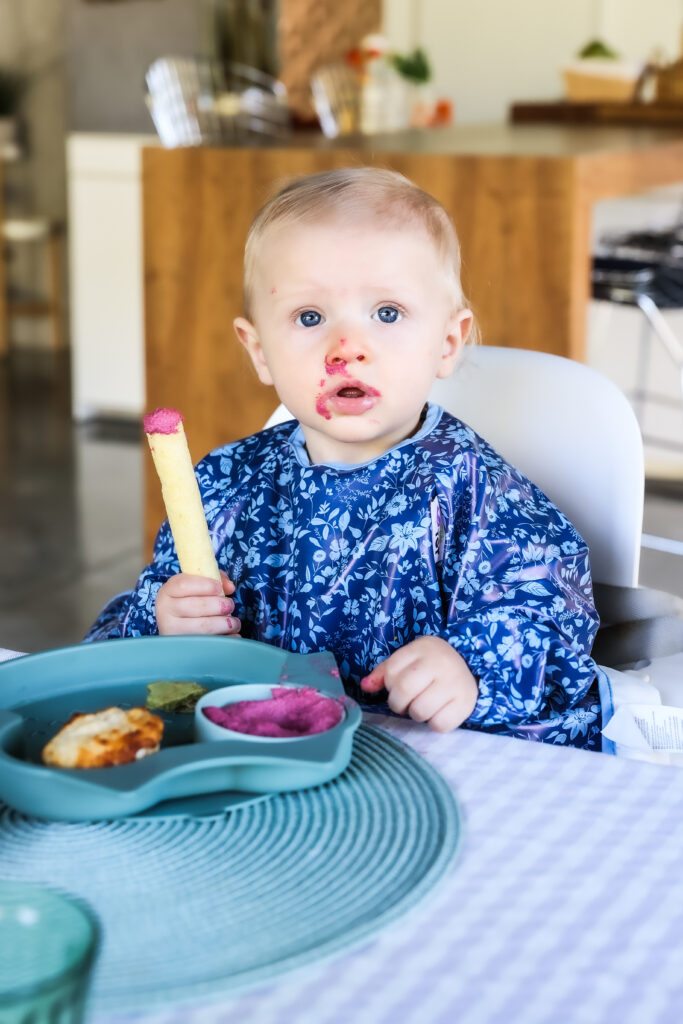
Imagine that a piece of something is constantly slipping through his fingers.
You can reposition it or move it slightly closer so that the baby can then grab it himself.
You can also demonstrate a gesture by eating in front of him or adapt the format of a food that has become too difficult to grasp.
The goal is to provide him with just enough help so that he can continue his exploration.

Before intervening… wait a few seconds
This is probably one of the hardest things for us parents to do. 😅
Baby is trying to grab something.
He misses.
Our hand almost automatically goes to help him.
However, waiting a few seconds sometimes gives him the opportunity to look for another solution.
He can change the position of his hand, turn the food over, try another grip, or use his other hand.
And finally succeed.
This short wait does not mean that we refuse to help him.
It simply gives him the opportunity to try before someone else does the action for him.
And the spoon?
The spoon does not go against autonomy.
Some textures are simply difficult, or even impossible, to grasp directly with the fingers: yogurt, compote, thick puree, porridge…
You can then offer a pre-filled spoon : you place the preparation on it and then let the baby grasp the spoon and bring it to their mouth themselves.
Another solution is to use food as a carrier to transport certain textures. Everything is explained in our article on the carrier and the pre-filled BLW.
Over time, baby will gain coordination and gradually begin to try to fill their own spoon.
And yes, the first attempts may end up more often on the table than in his mouth.
That's also how we learn.
For the next step, you can also find out when to introduce cutlery and a plate to baby's mealtimes.
Why is the baby putting so much food everywhere?
Because he is learning.
But not only that.
Food may fall because the baby is still unsure of their grip, is holding too tightly or not tightly enough, is trying to move the food, or is simply experimenting with what happens when they let go.
At other times, throwing can also mean that he is no longer hungry, that he is tired, or that he is trying to provoke a reaction.
In other words, not everything that ends up on the ground necessarily has the same meaning.
If your baby has reached the stage where they methodically toss every morsel overboard, our article Why does my baby throw food on the floor? will help you understand this behavior and how to react.
Allowing exploration does not mean allowing free rein
Respecting a baby's autonomy does not mean that there are no longer any rules during mealtimes.
You can absolutely set simple limits.
If baby willfully throws food over and over again and no longer seems interested in his meal, you can calmly remind him that the food stays on the table and observe if he wants to continue.
If he shows that he has finished, the meal can simply end.
Autonomy is also built within a reassuring and predictable framework.
What if the baby takes a very long time to eat?
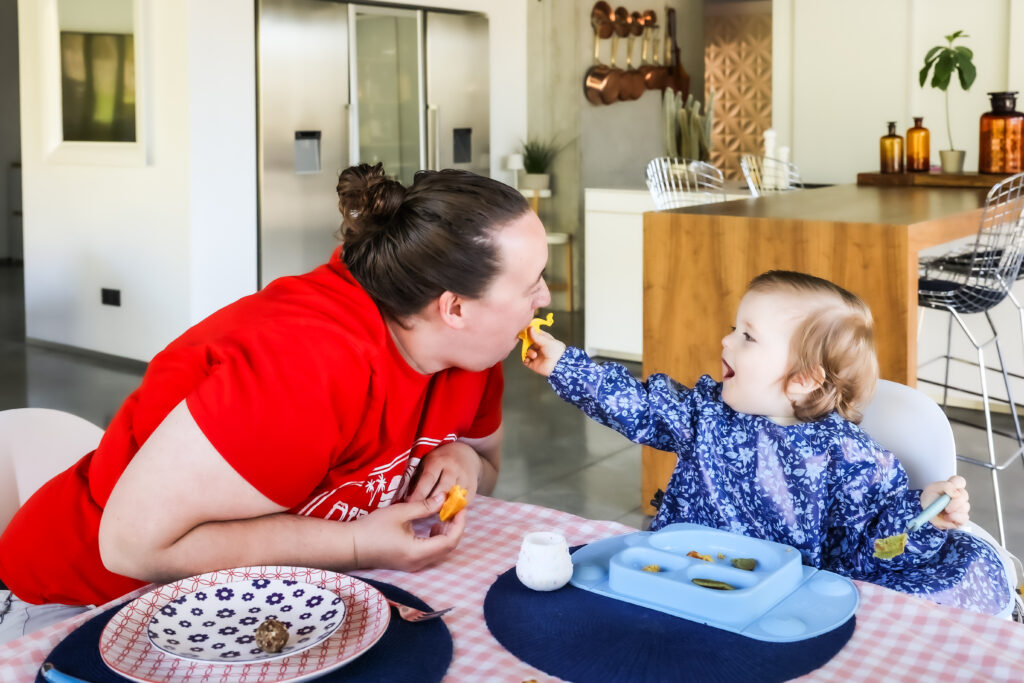
A baby learning to eat on its own will obviously be slower than an adult.
He observes, manipulates, tries, and starts again.
No need to time every meal.
On the other hand, if the baby is very tired, gradually loses all interest or clearly shows that he has had enough, prolonging the meal in the hope that he will eat a few extra pieces is not necessarily useful.
We can simply stop when its signals show that it has finished.

How can we promote independence without complicating every meal?
A few small adjustments can already make a big difference.
Offer a small amount of food at a time
It is not necessary to fill the entire tablet.
A few pieces are enough.
If he wants more, you can simply add more.
This sometimes makes eating easier and also limits the big mess around the chair a little.
Choose suitable formats
Food that is impossible to grasp is more likely to generate frustration.
Initially, the pieces should be large enough to be grasped with the whole hand and their texture should be adapted to the baby's abilities.
The formats will then evolve with its handling.
Properly position baby
To eat independently, a baby must also be able to use their hands, arms, and body correctly.
Proper installation is therefore essential. If you have any doubt about your equipment, check that your baby is in the correct position and that their high chair is suitable for the BLW.
Accepting a little bit of mess
There probably isn't a perfectly clean BLW . 😅
A bib that covers, appropriate protection, or a system to limit what ends up on the floor can clearly make everyday life easier.
The goal is certainly not to prevent the baby from touching food.
It's more about creating an environment in which we can let him experiment without spending the whole meal anticipating the cleanup that awaits us afterwards.

But autonomy never means eating without supervision
Baby can eat alone, but should never be alone while eating.
An adult must remain present and attentive during the meal.
The baby must also be properly positioned and the food offered must have a shape and texture suitable for their abilities.
Before starting to diversify, take the time to learn the safety rules in BLW and check how to adapt foods that present a risk of choking.
Autonomy never replaces safety.
How to find the right balance between helping and letting things happen?
A very simple question can help you:
"Does the baby really need me to succeed, or do I just want to help because it would be faster?"
Sometimes, he will really need you.
At other times, it will only take him a few extra seconds.
Therefore, you can observe before intervening, show rather than do, facilitate access to food or offer a suitable tool.
Then let him take over again.
The goal is not to have a baby who is perfectly independent at every meal.
It is simply a matter of giving him enough space to gradually develop his own skills.

In summary
Letting a baby eat on their own is not just about putting a few pieces of food in front of them.
Each time he catches, touches, crushes, puts in his mouth, misses and then tries again, he experiments and gradually develops his skills.
He gains coordination, precision and autonomy while discovering food with all of his senses.
This does not mean that we should refuse to help him.
Our role is rather to support him without systematically doing things for him.
So yes, for a while, part of the meal will probably end up on the baby, on the tablet, and sometimes in places that no one really understands.
But behind this joyful chaos, there is also a lot of learning.