At the beginning of BLW, we generally know where to go: large pieces, sufficiently meltable and easy to grab with the whole hand.
But a few weeks or months later, a new question often arises:
When should you start cutting food into smaller pieces?
Do we wait 8 months? 9 months? Until the teeth appear? Until the thumb-index finger pinch?
In reality, there is no specific date on which you should suddenly change the entire baby's plate.
Ages can serve as a guide, but it is above all the baby's abilities, their grasping and their ease with food that will guide us.
Age is a guideline, not a deadline
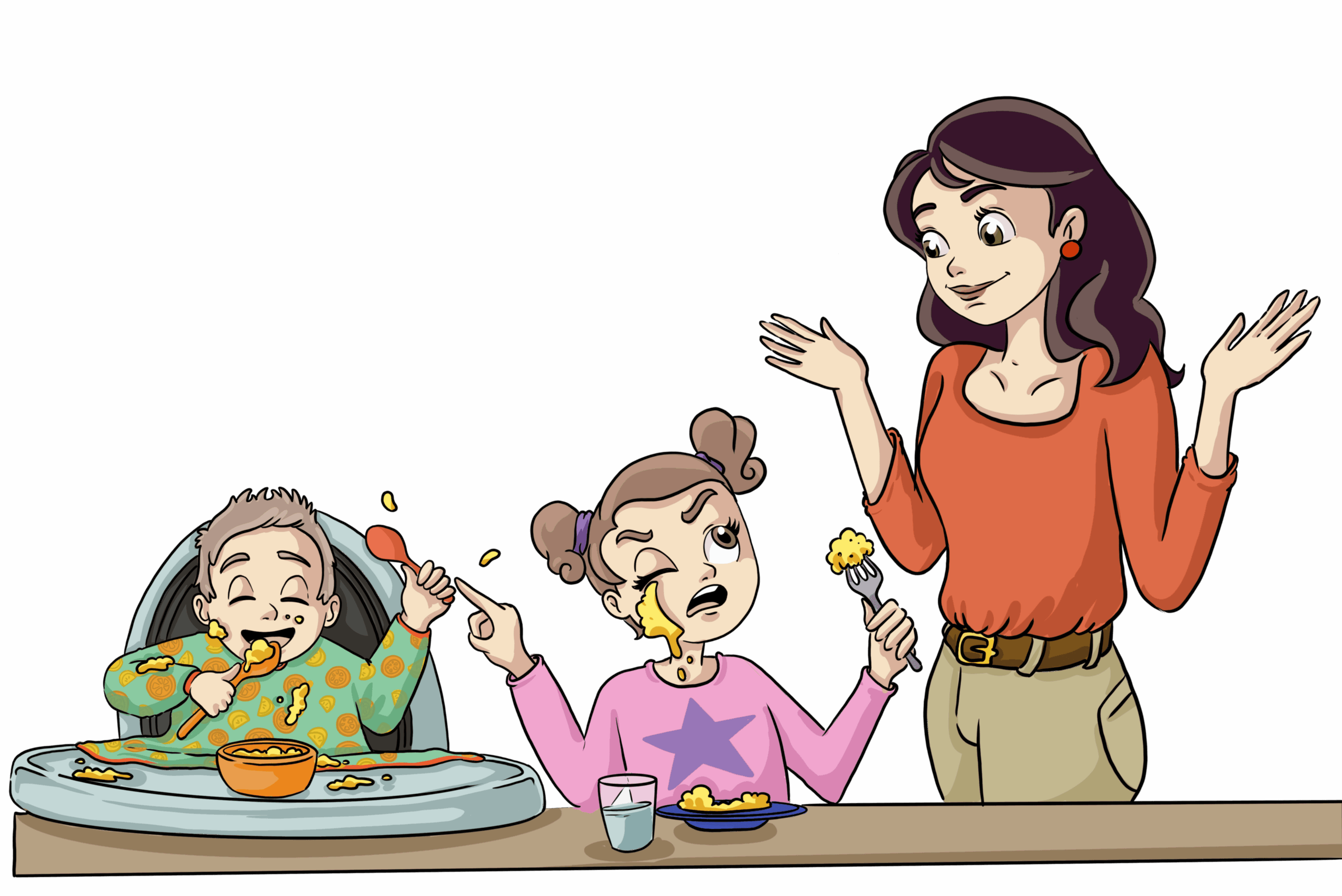
Two babies of the same age will not necessarily grasp, manipulate, or eat food in the same way.
One will still mainly use their whole hand while the other will already begin to grasp small pieces between their thumb and forefinger.
And that's perfectly normal.
The development of the pieces doesn't happen overnight. We will gradually adapt their size, shape, and texture to what the baby is capable of doing.
And most importantly: several formats can perfectly coexist on the same plate.
At first: baby grabs with their whole hand
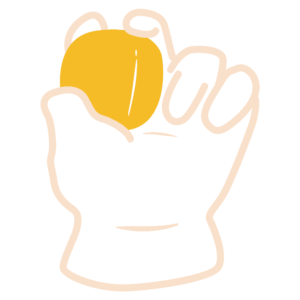
At the beginning of BLW, baby usually uses a palmar grasp : he grabs the food with his whole hand and closes his fingers around it.
The small pieces are therefore still difficult to catch.
We prefer foods that are large enough for the baby to hold in their fist while leaving part of the piece sticking out.
An easy reference point: a piece roughly the length of an adult's finger.
For example :
- a broccoli floret with its stem;
- a large sweet potato fry;
- a sufficiently large slice of avocado;
- a quarter of ripe and suitable fruit;
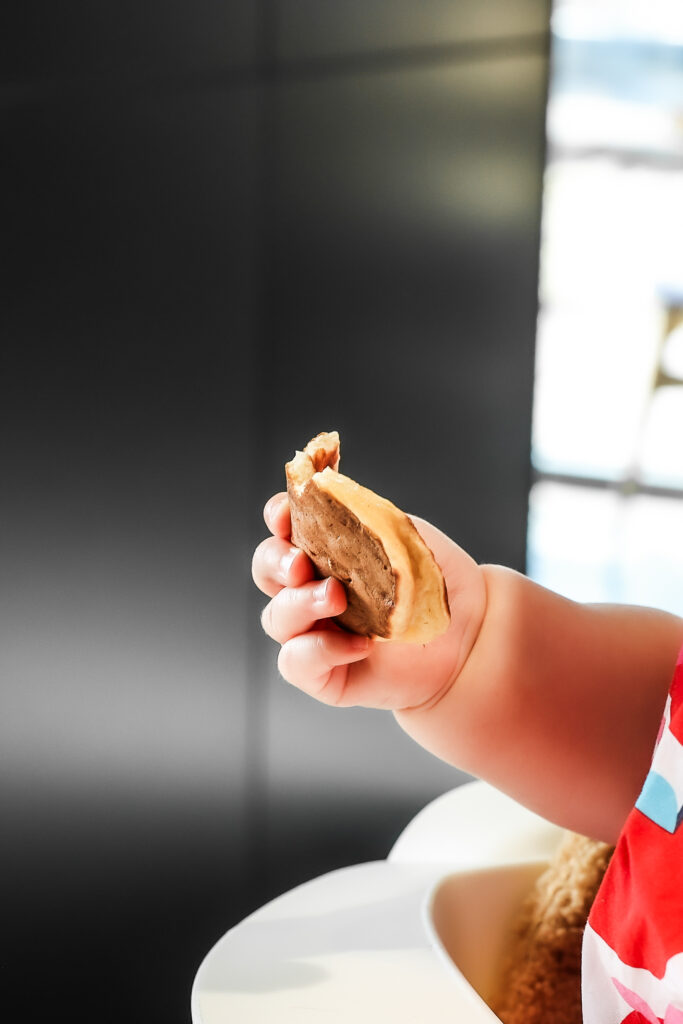
- a pancake or an omelet cut into strips.
But size isn't everything.
Texture is just as important : food should be soft enough for the baby to easily crush or break apart in the mouth.
Naturally hard foods, such as raw apples or carrots, must therefore be adapted before being offered.

Next, the grip becomes more precise
Little by little, the baby gains better control of their hands and fingers.
He no longer simply closes his entire fist around a food item: he begins to use several fingers with greater precision.
At that point, we can gradually vary the formats more.
It is not necessary to go directly from the large stick to the tiny little cube.
You can offer different sizes and shapes on the same plate and observe how the baby manipulates them.
The goal is not to make him take a "step", but to allow him to continue experimenting with foods adapted to his abilities.
When the thumb-index finger pinch appears
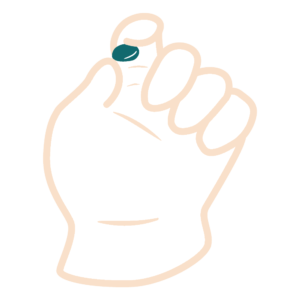
As their fine motor skills develop, babies gradually begin to grasp small objects between their thumb and forefinger.
That's the famous clamp.
It often appears around 9 months, but again: this is just a guideline.
When baby masters this pincer grasp, small pieces become much more interesting to him, since he is now able to grasp them on his own.
We can then start to offer more:
- small pieces of suitable food;
- small melting cubes;
- food cut into shorter pieces;
- items that he can select one by one from his plate.
This does not mean that all the large pieces should be removed.
Baby can very well eat a large piece of broccoli alongside small pieces of another food.
How do you know if baby is ready for smaller pieces?
Rather than just looking at his age, observe him during his meals.
You can gradually change the formats when you notice, for example, that:
- baby grasps food with greater precision;
- he is using less and less of his entire palm;
- he begins to use the tips of his fingers;
- The thumb-index finger pinch appears;
- It easily handles the formats you already offer it;
- He seems comfortable bringing food to his mouth and handling it.
There's no need to tick all the boxes before proposing something new.
We observe, we test a suitable format and we see how baby does.

Piece size and texture: these are not the same thing
This is an important point.
The fact that a baby is able to grasp a small piece does not automatically mean that he is ready to handle any texture.
The grasping ability tells us primarily about its fine motor skills and its capacity to grasp food.
At the same time, the baby also gradually develops skills to bite, chew, move food in their mouth and swallow it.
The texture of meals can therefore also evolve gradually, depending on what the baby can handle.
We continue to adapt foods that present a risk of choking, regardless of the baby's age.
And what about teeth in all of this?
You don't need to wait for a mouth full of teeth to evolve the pieces.
Babies are capable of crushing many soft foods with their gums.
The appearance of teeth is therefore not the main criterion for deciding the size of the pieces.
Once again, we mainly look at the texture of the food and the baby's abilities.

When should you offer a spoon or a fork?
Cutlery can also gradually become part of meals.
And there's no need to wait until the baby knows perfectly how to use a spoon all by themselves.
For preparations that cannot be easily picked up with the hands, such as yogurt, porridge or certain thick purees, you can offer a pre-filled spoon.
You fill the spoon, then place it or present it to the baby so that he or she can grasp it and bring it to their mouth themselves.
The spoon then simply becomes an carrier .
With time and the development of their coordination, baby will gradually begin to try to fill their own spoon or use a small fork.
Again, no performance is expected: at first, there will probably be as much food on and around the baby's chair as in their mouth. 😅
Some safety guidelines to keep in mind
Even as baby becomes more skillful, the basic safety rules remain the same.
Baby must be:
- properly installed and sufficiently straight;
- awake and ready to eat;
- always supervised during his meal.
Food must remain suitable in order to limit the risk of choking.
And most importantly, we offer the baby: we don't put the food directly into their mouth for them.

What if baby still prefers large pieces?
We're not worried.
The arrival of the clip does not mean that baby has to abandon the formats he/she has been using until now.
You can perfectly well continue to offer large pieces and gradually add some smaller formats.
Some babies will immediately want to grab every pea with surgical precision. Others will remain, for a while longer, big fans of broccoli with their whole hand. 😅
Both can be perfectly consistent with their development.
In summary
| What I observe in baby | What I can offer |
|---|
| He mainly grabs with his whole hand | Large, melting chunks that protrude from his fist |
| His grip becomes more precise | Different shapes and progressively smaller pieces |
| He uses the thumb-index finger pinch | Small, suitable pieces that he can grab one by one |
| His coordination is improving | More experimentation with the spoon and fork |
Therefore, there is no specific day when one should switch from large to small pieces.
The songs evolve with the baby, not with the calendar.
Observe her hands, the way she handles food and her ease during meals: these will give you the best clues to gradually change what she eats.
6 answers