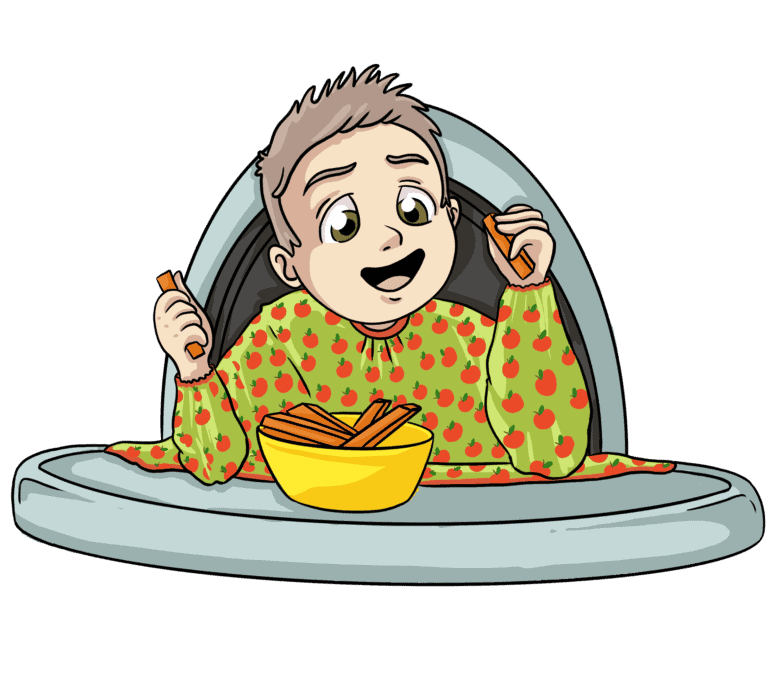
It's 6pm. You've prepared the meal, sat the baby down at the table and, while he eats rather well the rest of the day… tonight, nothing is going right.
He grumbles, turns his head away, throws food, demands to be held, or eats only a few bites before wanting to get up from his chair.
And inevitably, a question arises quite quickly: has he eaten enough?
The evening meal can be very different from other meals during the day. After several hours of wakefulness, a day at daycare or with a caregiver, new experiences and lots of stimulation, some babies simply arrive at dinner with almost no energy left.
So, when baby is too tired to eat in the evening, should you insist? Bring the meal forward? Offer something else? Compensate afterwards?
Let's focus on how to make this meal simpler, for both baby and you.
Why might the baby eat less in the evening?
A baby's appetite is not the same at every meal or every day.
Like us, he may be hungrier at midday than at dinner. But in the evening, another factor often comes into play: fatigue.
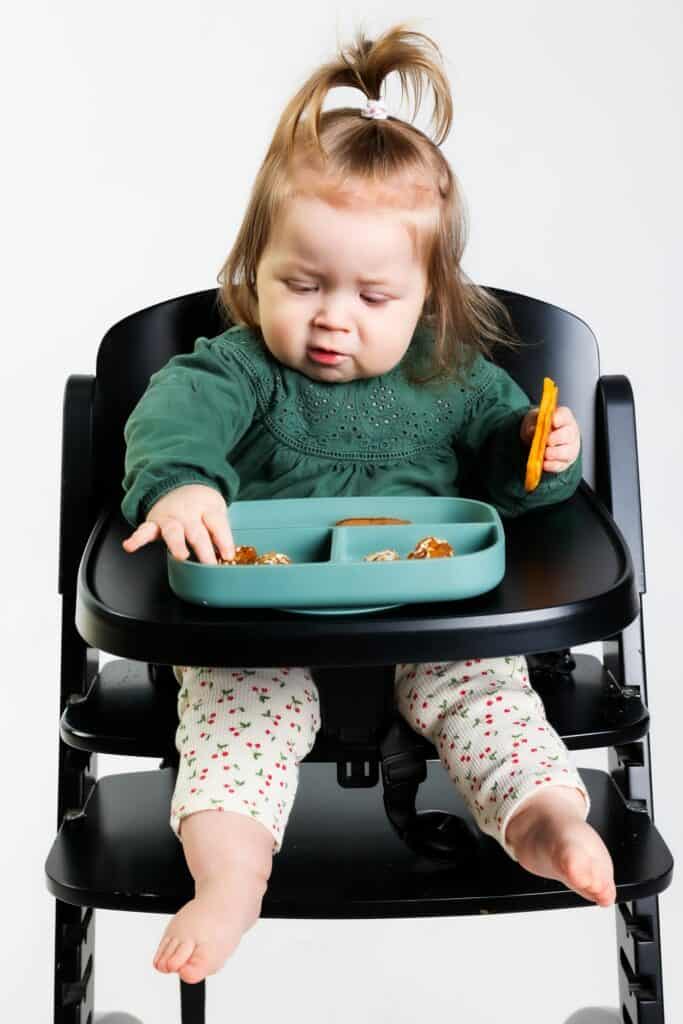
A tired baby may have more difficulty staying seated at the table, handling food, discovering a new texture, or simply remaining available to eat.
And this can be even more pronounced during periods when their rhythm changes: starting nursery, returning to the caregiver, new nap times, holidays, teething, important acquisition…
A complicated dinner does not automatically mean that baby "doesn't like to eat anymore" or that something is wrong with your BLW .
How can we tell if it's mainly fatigue?
There is obviously no behavior that allows us to say with certainty: "that's it, that's fatigue".
But the context can give you some clues.
For example, the baby usually eats better earlier in the day, but mealtimes regularly become difficult towards the end of the day. They may also rub their eyes, yawn, want to be held more often, get irritable easily, or have less patience when handling their food.
The idea is not to find an explanation for every food refused, but rather to look at the baby and their day as a whole.
Because a one-off refusal does not have the same meaning as a difficulty that is repeated at every meal, all day long.
Should we move the evening meal forward?
Sometimes, yes.
It is easy to imagine that a rhythm means: snack at such and such a time, dinner at such and such a time, bedtime at such and such a time.
But getting back into a rhythm doesn't necessarily mean following a schedule down to the minute.
If you find that your baby is regularly exhausted at 6:30 pm but still relatively available at 5:45 pm, trying an earlier dinner might be worthwhile.
You can try it for a few days and observe what happens.
Is he more available? Does he eat with more pleasure? Is the meal more peaceful?
It's not about finding the "perfect time" that works for all babies, but the arrangement that suits your child and your family.

What can I offer a very tired baby in the evening?
A busy evening is probably not the best time to embark on a recipe requiring 45 minutes of preparation and offering five new culinary discoveries. 😅
You can absolutely opt for a familiar meal that is easy to handle and quick to prepare.
Some examples depending on the baby's age, abilities, and foods already introduced:
- a pancake or a soft galette with a vegetable;
- an omelet accompanied by suitable vegetables;
- pasta with a vegetable sauce ;
- tender vegetables accompanied by a suitable protein source;
- a portion of a previously prepared and frozen meal.
The goal is not to create a "special menu for tired babies". It's simply to remind you thata simple meal is still a real meal.
Preparing a few portions in advance can also prevent you from being in the middle of negotiating with a zucchini at 6:12 pm, with a tired baby in your arms. 😂
What if he only eats a few bites?
This is often when parental anxiety rises a notch. You had planned his dinner. Baby eats two or three pieces and then seems to have finished.
Should we try to get him to eat more?
In BLW , as more broadly in responsive feeding, the parent offers food and the child remains attentive to their hunger and satiety signals. The quantities consumed can vary enormously from one meal to the next.
Rather than judging her diet solely based on this one dinner, take a broader view: how were her other meals? And the last few days?
At this age, breast milk or infant formula also retains an important place in the baby's diet, particularly during the first year.
👉"When should I feed a baby three times a day on a BLW diet?"
Should we prepare something else if he refuses his dinner?
It's tempting.
Baby refuses the meal and our brain immediately starts reviewing everything he might accept: another dish, then another food…
But it is not necessary to transform each refusal into a succession of menus until we find the one that will be eaten.
You can offer a suitable meal, let the baby decide what he/she wants to eat, and remain attentive to his/her signals.
This doesn't mean being rigid. If you realize that the meal is truly unsuitable for the situation or the baby's abilities, of course, you can adjust it.
The main idea is to avoid gradually entering a logic where every rejected food must immediately be replaced by something more likely to be accepted.
Should we compensate because he ate little?
A small dinner doesn't necessarily need to be "made up for".
A baby's diet cannot be balanced on a single plate.
Her appetite varies, and her intake should be considered within a broader context. Continue to follow her usual feeding schedule, whether breastfeeding or bottle-feeding, without systematically changing it simply because a solid meal was smaller.
This is one of the reasons why it is interesting to observe several meals and several days, rather than measuring the success of a day by the contents of the evening plate.

What if all evening meals become complicated?
If this happens occasionally, you can mainly observe and test a few adjustments:
Slightly move dinner forward, simplify what you offer, check the time and composition of the afternoon snack, observe signs of fatigue and possibly review the meal-bath-bedtime sequence.
But if the problem recurs, take a step back and look at the bigger picture.
Is it only in the evening? Does the baby eat normally at other times? Has their behavior changed recently? Are the difficulties related to certain textures or all foods? Do mealtimes consistently become a source of stress?
These observations can help to distinguish a simply difficult end to the day from a more general eating problem.

When should you seek advice from a professional?
Fatigue may explain some small evening meals, but it should not become an automatic explanation for a persistent difficulty.
If your baby regularly refuses to eat at different times of the day, seems to have difficulty or pain when eating, shows signs that worry you, or if you have questions about their growth or intake, talk to the healthcare professional who is treating your child.
You don't need to wait until a situation becomes "serious enough" to ask a question.
Dinner doesn't have to be perfect
Some evenings, the baby will eat with enthusiasm.
Others will try a few bites before deciding that sleeping, being in your arms, or watching the spoon fall on the floor six times is clearly a much more interesting prospect. 😅
What matters is not making every dinner a success.
If your baby regularly arrives exhausted at mealtimes, you can try moving the time earlier, simplifying what you offer, and observing their diet over the whole day rather than on a single plate.
Because a simpler evening meal can sometimes be exactly what the whole family needed.