
One day, baby devours everything you offer him.
The next day, he eats three pieces, plays with the fourth… then clearly decides that the meal is over. 😅
And inevitably, the question arises:
"Has he really eaten enough?"
Seeing your baby eat little can quickly become a source of worry. You wonder if they are getting enough nutrients, if you should offer them something else, insist a little, or try to get them to eat a few extra bites.
However, a baby's appetite is not linear.
It can vary depending on the day, meals, fatigue, health, development, or simply the hunger of the moment.
So how do we know when to let go… and when a food refusal deserves more attention?

How much should a baby really eat?
This is probably one of the most frequently asked questions when starting to diversify.
And yet, there is no perfect amount that every baby should absolutely eat at every meal.
Two babies of the same age can eat very different amounts while each having a diet adapted to their needs.
Even in a single child, appetite can change dramatically:
He can eat a lot at lunch and very little in the evening;
to be very hungry for several days and then less so the following week;
eat more of certain foods than others;
to demand more milk at certain times;
simply not being hungry when the meal is offered.
The recommendations obviously provide guidelines regarding the frequency of meals and the progression of complementary feeding, but these guidelines should not become a goal to be achieved bite by bite.
In practice, rather than precisely counting what baby swallows, we look at the whole picture: the variety offered, their diet over several days, their milk, their development and especially their hunger and satiety signals.
Are you also wondering when to increase the number of meals? Check out our article "When to feed your baby 3 meals a day on BLW ?"
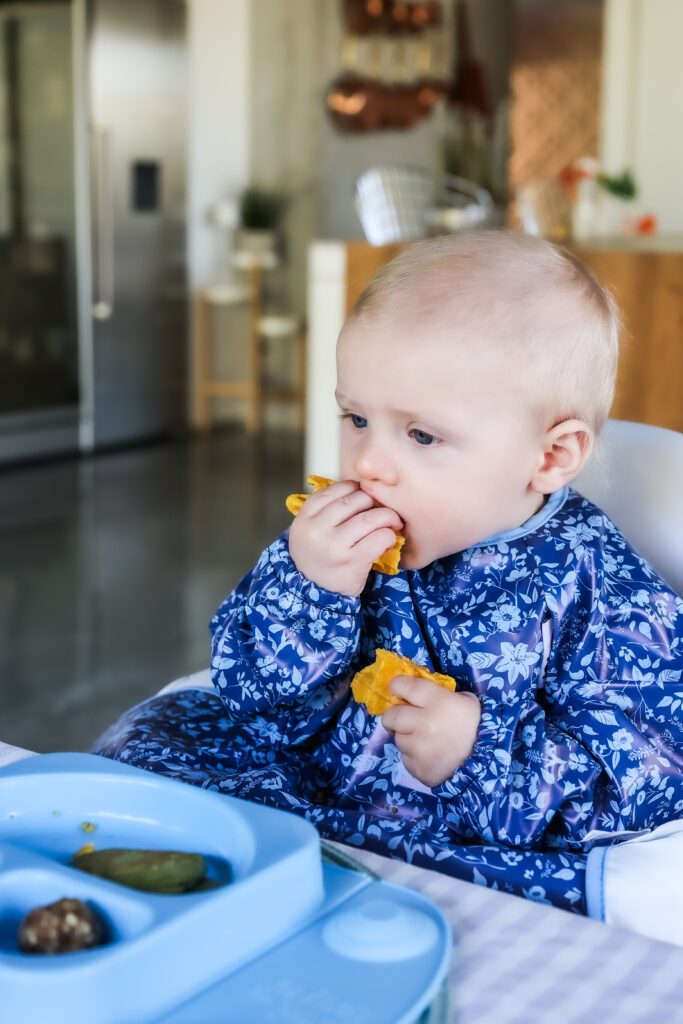
At the beginning of BLW , eating and discovering go together
When a baby starts weaning, they learn a lot of things at the same time.
He discovers:
new flavors;
unknown textures;
different temperatures;
smells;
shapes;
the sensation of food in her hands and then in her mouth.
So he will touch, crush, smell, lick, sometimes throw... and eat too.
Some meals will look like he actually ate them. Others will look more like a science experiment being conducted right on the tray table of his chair. 😅
All of this is part of the learning process.
But that does not mean that solid food is unimportant during the first few months.
From about 6 months, a baby's nutritional needs increase and food gradually begins to complement breast milk or infant formula, which nevertheless retains an important place in their diet.
The quantities will generally increase little by little, in line with his discoveries and capabilities.
If you are at the very beginning of the adventure, you can also consult When to start BLW ? The signs that baby is ready.
Is the baby eating very little… or is he simply no longer hungry?
Sometimes we have a very precise idea of what baby should eat.
We prepare three foods, arrange our plate nicely and, unconsciously, this quantity becomes in our mind "our meal".
If he eats half of it, then we may get the impression that he has "hardly eaten anything".
For babies, the logic is different.
He doesn't know the quantity we planned for him. He eats according to his feelings.
This is where learning to recognize these signals becomes particularly interesting.
How to recognize the signs of hunger?
Every baby has their own way of communicating, but when they are hungry, you can observe that they:
shows an interest in food;
leans towards his meal;
reaches out for the food;
opens its mouth when it sees food;
becomes enthusiastic when the meal arrives;
tries to grab whatever is in front of him.
The older the baby gets, the easier it becomes to identify its signals.
The goal is obviously not to wait for him to show all these signs before every meal, but rather to gradually learn to recognize his rhythm.
And how do you know when the baby is no longer hungry?
Signs of satiety are just as important.
For example, a baby can:
turn your head away;
close your mouth;
to repel food;
slow down its pace considerably;
start playing with food more than eating it;
try to get out of his chair;
to lose all interest in his meal.

Throwing food on the floor doesn't always mean "I'm not hungry anymore." Babies also throw things to experiment, observe, or test a reaction.
But when several signs appear together, it is possible that the baby has simply finished eating.
And in this case, a few extra bites are not necessary simply because the plate is not empty.
Why does the baby eat less on some days?
Like us, baby doesn't have exactly the same appetite every day.
Many factors can influence a meal.
Fatigue
Eating requires concentration and coordination.
An exhausted baby may be hungry but no longer be available enough to sit up, pick up their food and eat it quietly.
This is particularly common in the evening.
If this sounds like what you're experiencing at home, we've dedicated a whole article to the topic: Baby is too tired to eat in the evening: what to do?
Teething
When gums are sensitive or painful, certain foods can become much less appealing.
Baby may temporarily prefer certain textures or eat less than usual.
An illness or a minor cold
A stuffy nose, fever, or simply a day when baby isn't feeling well can reduce their appetite.
In these moments, we adjust our expectations and pay particular attention to our hydration and general condition.
You can find our advice in What to do when baby is sick?
A period of great learning
Motor skills, movement, language, discovering the world…
Baby is constantly going through new stages.
Some days, sitting for a long time in front of a plate of food seems obviously much less exciting than everything else around it.
The rhythm of the day
A recent bottle or breastfeeding session, a delayed snack, a long nap, or simply a change in schedule can also alter one's appetite.
Before concluding that the baby "is no longer eating", it may be helpful to look at the day as a whole.

What can you do in practice when your baby eats very little?
The first thing: avoid turning the meal into an ordeal.
It is perfectly possible to support the baby while respecting their appetite.
1. Start with a small amount
A huge plate is not necessary.
You can start with a few pieces and add more if baby wants more.
It's often simpler for the baby... and easier for us when only two bites are eaten.
2. Continue to offer variety
Baby doesn't need to like or eat everything that is offered.
Our role remains to gradually offer him a varied and appropriate diet.
He might eat the apple and completely ignore the broccoli today, then do the opposite next week.
3. Observe before intervening
When it slows down, wait a few moments.
Has he really finished?
Is he distracted?
Is he simply trying to manipulate the food differently?
We sometimes tend to intervene very quickly while the baby is still managing their meal.
4. Accept that some meals will be tiny
A very light meal does not necessarily need to be "recovered".
Baby will have other opportunities to eat during the day.
It's the overall diet that counts, not the success of each meal taken separately.
5. Share the meal when possible
Watching others eat can naturally encourage a baby to participate.
There's no need to turn every meal into a perfect big family meal, but eating together when the organization allows can make this moment more natural and enjoyable.
We develop this topic in Is it important to eat at the same time as the baby?
Should we prepare something else if he refuses his meal?
This is probably one of the most tempting reflexes.
Baby refuses what we've prepared and our brain immediately starts taking stock:
"Maybe he'd eat a banana? A yogurt? Something else?"
However, it is not necessary to systematically transform each refusal into a succession of menus until something is found that the baby will inevitably accept.
Did you offer a balanced and suitable meal?
You can let him decide what he wants to eat.
Obviously, this does not preclude adapting.
If the meal is too difficult to handle, if the baby is sick, very tired, or if you simply realize that the situation is not suitable, we adjust.
The main idea is to avoid a situation where "I don't want it" systematically leads to the immediate arrival of a favorite food.

What if he refuses a food he used to love?
Welcome to one of the great mysteries of children's nutrition. 😅
Yesterday, courgette was clearly the pinnacle of gastronomy.
Today, it is received as a personal offense.
It happens.
Food preferences change and a food that is once enjoyed may be temporarily rejected.
Therefore, it is not necessary to remove it permanently from the menu.
Just keep bringing it up from time to time, without any pressure.
We discuss this in more detail in our article Why does baby love a food… then refuse it?

Beware of the subtle pressure that builds up without you realizing it
Food touches on something very sensitive for parents.
Feeding your baby is taking care of him/her.
So when he doesn't eat what we've prepared, it's very easy to feel stressed.
And without necessarily meaning to, certain phrases begin to appear:
"Just one more bite."
"At least try this."
"You've hardly eaten anything."
"Look, Mom's eating, come on!"
A small spoon that makes an airplane, then two, then an attempt at distraction with a toy…
These are often reflexes made with the best intentions in the world.
But the goal is to gradually let the baby learn to recognize their own hunger and satiety.
In responsive nutrition, everyone ultimately has their role:
The parent decides what to offer, when and in what setting for the meal.
The baby decides if and how much he wants to eat.
This does not mean that the baby is "ordering the menu".
This simply means that once a suitable diet is offered to him, we do not need to decide for him how many bites his body needs.
When it's hot, appetite can also change
On very hot days, some babies eat less or show more interest in certain fresh, water-rich foods.
This is not necessarily worrying if the baby remains healthy and properly hydrated.
We continue to offer meals without pressure, breast milk or infant formula, as well as water according to age and relevant recommendations.
You will find more advice in our article How to properly hydrate baby when it is hot?
How can I tell if my baby is eating enough?
Rather than judging solely by the amount left on your plate at lunchtime, take a step back.
Look at the baby as a whole.
Some elements are much more interesting than counting bites:
its evolution along its growth curve;
its general condition;
his energy and alertness level;
its hydration;
her wet diapers;
its development;
feeding him over several days rather than in a single meal.
A baby who eats little at a meal but is otherwise healthy, drinks normally and continues to develop is not in the same situation as a baby who refuses all food for a long time and whose general condition deteriorates.

When should you seek medical advice?
A one-off refusal or a few days of fluctuating appetite are very different from a significant and persistent change.
Consult your doctor or pediatrician, especially if:
Are you worried about your baby losing weight or their growth?
His food intake decreases sharply for several days;
he also refuses his milk or liquids;
you are observing significantly fewer wet diapers;
baby seems unusually drowsy, weak or apathetic;
Eating seems to cause him significant pain;
He vomits repeatedly;
You have the feeling that something is wrong.
And most importantly: you know your child.
You don't need to wait until a whole list of signs is present to seek advice if you are concerned about their behavior.
In summary
A baby does not eat exactly the same amount at each meal.
And thankfully, neither do we. 😉
Her appetite may vary with fatigue, teething, illness, the rhythm of her day or simply her needs at the moment.
In BLW , our goal is therefore not to make him complete a predefined portion.
We offer a suitable, varied and nutritious diet.
We are observing.
We provide support.
And the baby gradually retains the ability to listen to their feelings of hunger and satiety.
Our role is to make suggestions. The baby decides how much he wants to eat.
An answer