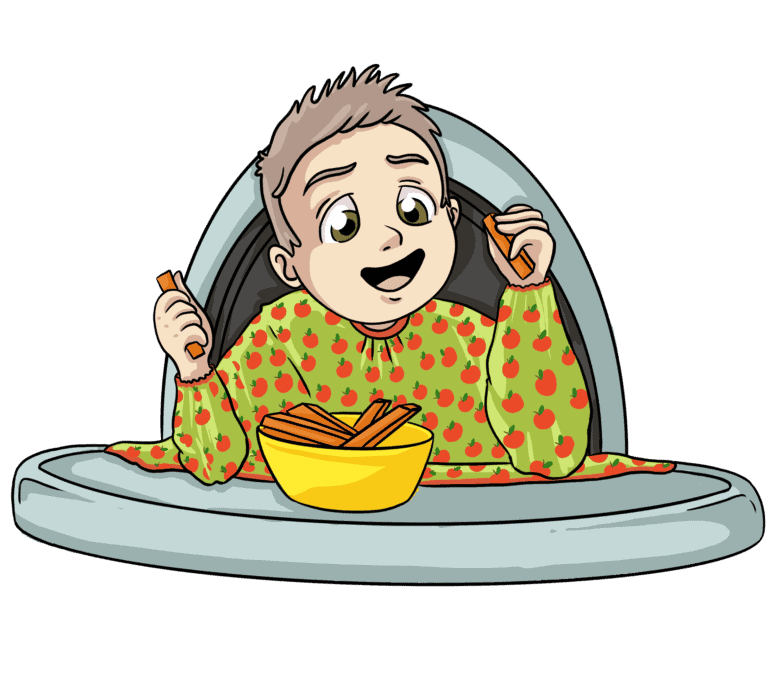
Back to school is approaching, baby starts nursery, goes to a childminder, a nanny or spends more time with grandparents… and with this new childcare arrangement, many questions often arise about BLW and meals.
"Will they accept BLW ?"
"What if they're afraid of lumps?"
"At Grandma's, they give him things I don't offer at home... what do I do?"
Or the classic question: "Why does he eat everything at daycare but refuse it with me?" 😅
The good news is that baby food doesn't need to be exactly the same everywhere.
Babies are capable of adapting to different environments, different people, and different habits. The goal isn't for everyone to exactly replicate your meals at home, but rather to understand which rules are essential, which can be adapted, and how to communicate without turning every meal into a diplomatic summit.
First and foremost: conveying the essential rules of BLW
When baby starts being looked after, the first step is simply to explain how he/she eats at home.
Some people are already very familiar with baby-led weaning. For others, seeing a 6 or 7-month-old baby grab a piece of broccoli can be quite baffling.
And that's understandable.
Rather than trying to convince at all costs, explain concretely what the baby can already do, the foods he is used to eating and the important rules to follow.
In particular, you can pass on our essential safety rules in BLW: baby must be properly positioned, food must have an appropriate texture and format, the meal must always take place under the supervision of an adult and baby must remain an active participant in their meal.
It may also be helpful to explain the difference between true choking and the gag reflex, which can be very impressive if you have never witnessed it.

The idea isn't to give grandma a 47-page manual 😅
A few clear and important pieces of information are often better than an avalanche of recommendations.
For example, you can transmit:
- essential safety rules;
- some examples of formats that baby already masters;
- foods to avoid or adapt;
- the way in which you wish their hunger and satiety to be respected;
- any allergies already identified and the associated instructions.
The rest can be learned gradually.
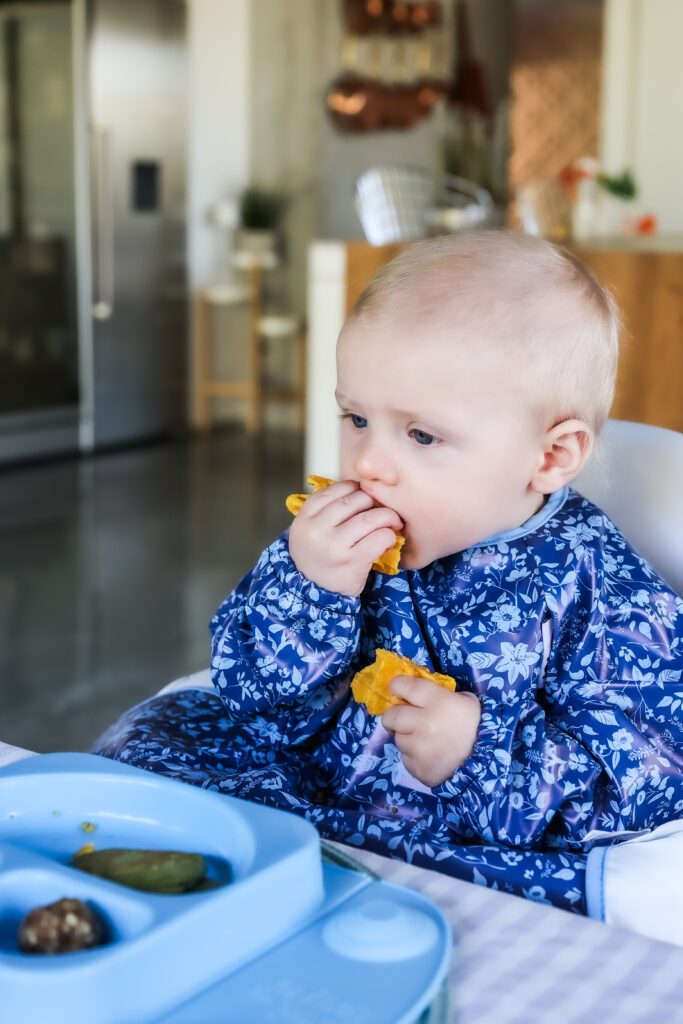
How to continue BLW with a custody arrangement?
If the nursery, nanny, childminder or grandparents are comfortable with BLW , this is obviously the simplest situation.
If your baby is just starting weaning, there's no need to immediately try to replicate all their meals everywhere. Breast milk or formula remains an essential part of their diet, and new foods can be introduced gradually.
When the baby starts to feel more comfortable, a very good solution is to show a meal to the person who will be looking after him/her.
Watching a baby handle a piece of food, bring it to their mouth, chew it with their gums or manage a gag reflex is often much more reassuring than ten theoretical explanations.
You can also show how to offer certain foods according to their age and developmental level.
What if the person looking after the baby is afraid of pieces of food?
This is an extremely common situation.
A daycare center may have its own way of operating. A childminder or nanny may not have been trained in BLW Breastfeeding and Weaning). A grandparent may simply have experienced a very different weaning process.
This does not mean that you should abandon BLW .
Depending on the situation, baby can receive purees, compotes, yogurts or other suitable textures elsewhere, then continue to eat independently when with you.
You can also offer pre-filled spoons to keep him active during some meals.
Introducing solid foods doesn't need to be perfectly identical in all environments for a baby to continue developing their autonomy.
The most important thing is that the textures offered remain suitable for the baby's abilities and that meals take place in safe conditions.

"In my day, we didn't do it like that."
With grandparents, the difficulty isn't always just the fear of pieces. 😅
Recommendations have evolved, knowledge has changed, and some habits surrounding children's nutrition are different from those of previous generations.
So you can hear:
"He hardly eats anything!"
"Are you sure he can eat that?"
"A small spoon for Grandma..."
"He has to finish somehow."
Or, conversely, discover that some eating habits do not exactly match yours.
The goal is not necessarily to convince those around you that your way of doing things is the only right way to feed a baby.
On the other hand, you can clearly explain the rules you insist on and, above all, why some of them are important.
Which rules must remain non-negotiable?
This is probably the most important distinction to make when a baby regularly eats outside the home.
Security is non-negotiable.
Proper setup, supervision during feeding, appropriate textures and formats, prevention of choking hazards and respect for any allergies must be understood by anyone who feeds a baby.
Some important recommendations regarding baby's diet must also be conveyed, particularly concerning foods that are not suitable for their age.
However, not everything necessarily needs to be reproduced down to the millimeter.
The dishes might not be the same. The meal might be twenty minutes later. Grandma will prepare her zucchini differently. Baby might eat more at lunchtime and less in the evening.
And that's okay.
Different doesn't necessarily mean bad.

What if the grandparents offer different foods?
This is an issue that can quickly become sensitive, especially when habits regarding sugar, salt or certain foods are not the same from one generation to the next.
You have every right to express your choices regarding your child's diet. But not all differences are necessarily of the same importance.
A good way to approach the discussion is to distinguish between what relates to safety and -appropriate recommendations age, on which instructions must be followed, and small, occasional differences in daily life, which can sometimes be accepted with more flexibility.
If something is important to you, say so clearly rather than hoping the other person will guess.
And when a habit bothers you, explain why without necessarily turning the conversation into a judgment about how your parents raised you thirty years ago. 😉
The goal remains to build a framework in which everyone knows what really matters.

"At daycare, he eats everything. At home, he refuses. Why?"
This is a situation that can be particularly frustrating.
We pick up the baby and learn that he ate broccoli, fish and a good part of his meal.
That very evening, that infamous broccoli touched his plate and suddenly became public enemy number one. 😅
However, this behavior is not inconsistent.
He eats with other children
Watching others touch, taste, and eat can encourage babies to do the same. Imitation can play an important role in learning, including during mealtimes.
The person and the context change
A baby does not interact in the same way with its parents, an early childhood professional, or its grandparents.
Habits, atmosphere, schedules, and interactions around meals may be different.
At home, baby finds himself in his familiar environment
And it is also there that the fatigue accumulated during the day, one's mood, current appetite, or simply the desire to refuse something can be expressed more fully.
A more complicated meal at home does not automatically mean that you are doing something wrong.
Should we replicate at home what works at daycare?
You can obviously be curious.
Ask about mealtimes: What time does the baby eat? Does he/she eat with other children? What foods are offered? In what form? What is the atmosphere like?
This might give you some interesting leads.
But you don't need to turn your kitchen into an annex of the nursery.
And above all, try to avoid:
"But at daycare, you eat it!"
Although, let's be honest, the phrase can be VERY tempting. 😅
Continue offering food without pressure. A refusal at home today doesn't mean your baby no longer likes that food or that you need to find a strategy to make them eat it at all costs.
Repeated exposure to different foods, in a calm and pressure-free environment, is part of food discovery.

What if he eats more elsewhere than at home?
Again, look at the baby's diet as a whole rather than an isolated meal.
Her appetite can naturally vary depending on the day, time of day, amount of milk consumed, sleep, activity, development or general condition.
After a long day at daycare, some babies will simply be less hungry or have less energy at the evening meal.
What matters is not matching each plate.
Babies gradually learn to recognize their feelings of hunger and fullness. Our role remains to offer them appropriate food in a safe environment, without making the amount consumed a performance.
If, on the other hand, the refusals become very significant or persistent, involve many foods or textures, or worry you about your child's growth or diet, talk to a healthcare professional.
📌 Please share with anyone who feeds a baby
Before the first shifts, you can prepare a very simple little list.
Safety: how to position baby and which foods or formats to avoid.
Current habits: what he already eats and the textures he can handle.
Autonomy: what he can take on his own and how to use a pre-filled spoon if necessary.
Hunger and satiety: baby does not need to finish their plate.
Allergies: allergens already introduced, known allergies and specific instructions if necessary.
Your few important limits: rather than twenty difficult rules to remember, choose those that really matter to your family.
This small communication often helps to reassure everyone, including parents.
Accepting that baby doesn't eat exactly the same way everywhere
This is probably the most important message of this article.
Baby will gradually discover that there are different ways of eating, different people around the table and different habits depending on the place.
And this ability to adapt is also part of what he has learned.
Your goal is not to control every bite when he is not with you.
It's more about creating a framework that's clear enough so that you can then trust the person looking after the baby and the baby.
And sometimes, accepting that a meal might be slightly different at grandma and grandpa's also allows everyone to enjoy the moment more without turning every detail into a source of tension.
In summary
BLW can perfectly continue when baby goes to daycare, to a nanny, a childminder or to his grandparents.
The most important thing is to communicate the safety rules and essential information, and then accept that there may be some differences from one environment to another.
If the person looking after the baby is not yet comfortable with pieces of food, various adaptations are possible without questioning everything you do at home.
And if your baby eats more, differently, or accepts certain foods when they're not with you, there's no need to turn it into a competition between daycare and your kitchen. 😅
Observe, talk with the people who look after him and continue to offer him suitable meals without pressure.