Fruits are often among the first foods that parents want to offer their baby. Their naturally sweet taste, varied colors, and numerous textures make them wonderful foods to discover right from the start of weaning.
But one question keeps coming up:
How to safely introduce fruit to a baby?
Whether it's a soft pear, a crisp apple, or a cherry with its pit, not all fruits are presented in the same way. The texture of the fruit, its ripeness, and the baby's abilities will all influence how it's presented.
If you are just starting out with weaning, we also recommend reading our article When to start BLW ? to check that baby has the necessary prerequisites to start smoothly.
Can all fruits be offered raw?
The answer is no.
The first thing to observe is always the texture of the fruit.
Naturally soft fruits such as banana, ripe pear, kiwi, melon or avocado can generally be offered raw from the beginning of BLW .
Conversely, some fruits are too firm to be safely eaten. This is particularly true of apples, some unripe pears, or some peaches when they are still too hard.
In this case, light cooking will result in a melt-in-your-mouth texture more suitable for babies.
Just as with vegetables, texture remains one of the most important factors. You can also consult our article " How to introduce vegetables to your baby?" to discover the same principles applied to vegetables.
The presentation evolves with the baby's abilities
When starting BLW Baby's Light) training, it's tempting to rely solely on the baby's age. However, it's primarily their abilities that should guide the training formats offered.
Around 6 months, babies mainly grasp food with their whole hand. Therefore, the pieces should be large enough to extend beyond their closed fist.
Between 7 and 9 months, his grasping becomes more precise. He begins to use several fingers to grasp food.
Then gradually, it develops the fine pincers that will allow it to grasp smaller pieces.
Every child develops at their own pace. If you would like to better understand the different stages of nutritional development, we invite you to read our article " Baby Development".
The pear: an excellent fruit to start with
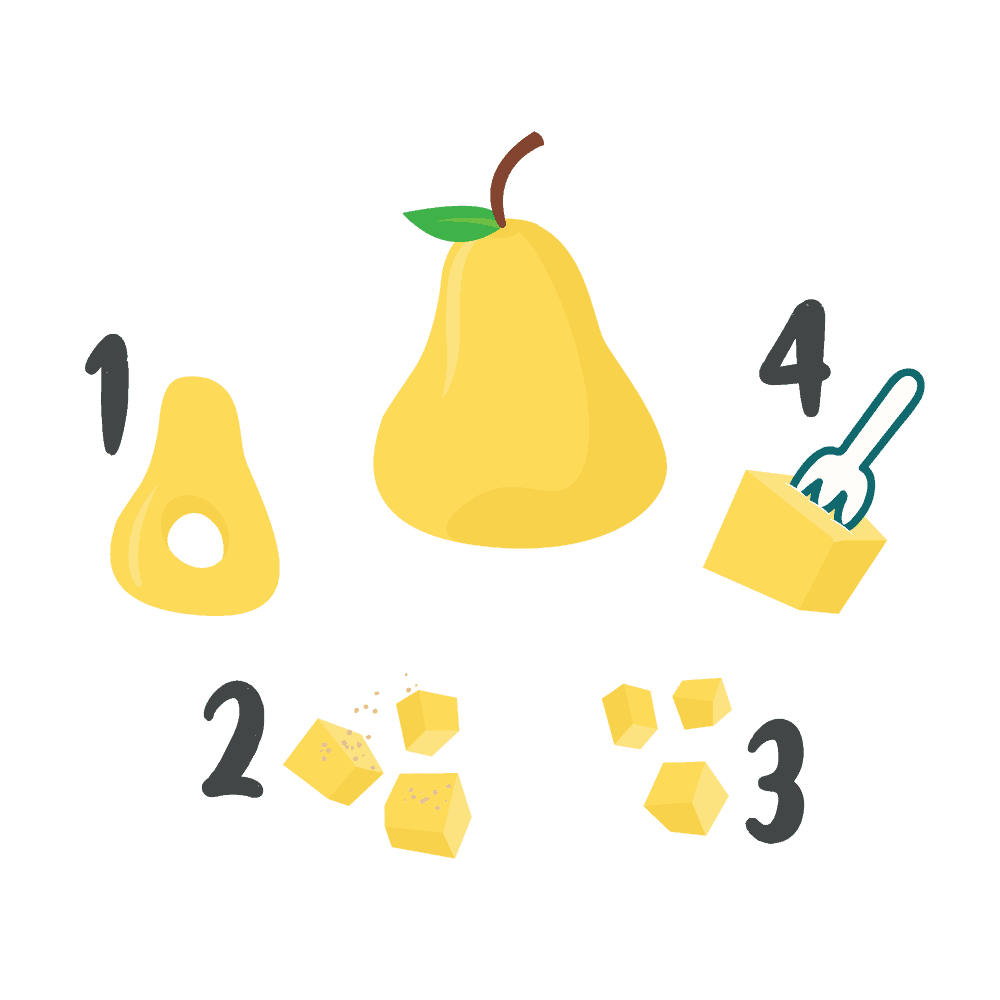
A ripe pear is often one of the easiest to offer at the beginning of BLW.
Around 6 months, it can be presented in quarters with a central part removed to create an easy grip for baby.
Between 7 and 9 months, it becomes possible to offer small pieces covered with almond powder, coconut or other food powders to prevent them from slipping through the fingers.
Once the fine pincer grasp is well acquired, the pieces can be offered individually.
Finally, depending on the baby's development, the pieces can then be offered directly on a fork.
Here is a table showing some examples of how to present fruit "as is." Once your baby is comfortable with pieces and the discovery phase is over, feel free to introduce fruit into preparations such as pancakes, waffles, crepes, etc.
SOME EXAMPLES OF RAW FRUIT PRESENTATIONS
Apple
Discovery phase:
- Cooked and melting quarters
- Compote on a pre-filled spoon
Development phase:
- Raw grated
- Thin slices
Pear
Discovery phase:
- Well-ripened neighborhood with a hole
Development phase:
- Small pieces coated in almond powder, coconut
- Small pieces
Kiwi
Discovery phase:
- Quarter with notches for easier gripping
Development phase:
- Kiwi cubes
Banana
Discovery phase:
- Banana cut in half with the peel on the end, or 1/2 banana cut into three
Development phase:
- Banana sticks
- Banana slices cut in half
Apricot
Discovery phase:
Cut in half without the pit
(Remember to remove the skin)
Development phase:
- Small pieces
Orange
Discovery phase:
- Orange supreme
Development phase:
- Small pieces
Grapes
Discovery phase:
- Cut in half and remove the seeds
Development phase:
- Cut into quarters and remove the seeds
Cherry
Discovery phase:
- Cut in half and remove the seeds
Development phase:
- Cut into quarters and remove the seeds
Khaki
Discovery phase:
Pre-filled spoon compote
Ripe pieces without skin
Development phase:
- Small pieces
Raspberry
Discovery phase:
Whole if they are large
Crushed onto a pre-filled spoon
Development phase:
- Cut in half
Strawberry
Discovery phase:
- Whole and skewered with a fork
Development phase:
- Small pieces
Melon
Discovery phase:
Sticks
Development phase:
- Small pieces
And what about dried fruit and nuts ? Click here to find out.

Once the initial discovery is over...
Once baby is comfortable with pieces of food, feel free to incorporate fruit into a variety of recipes:
- pancakes
- waffles
- muffins
- compotes
- cakes
- crepes
- smoothies
These different preparations allow the baby to discover several textures and several ways to enjoy the same food.
You can also find our Baby Breakfast Ideas as well as our many recipes using seasonal fruits.
✨ Practical guide: the most common mistakes
✔️ Offer a fruit that is still too hard
✔️ Forgetting to remove the pits or seeds
✔️ Moving too quickly to small pieces
✔️ Compare the baby's development to that of another child
✔️ Absolutely wanting him to eat a specific amount
In BLW , the primary objective is to discover and explore.
🌿 In summary
Fruits are excellent allies for starting BLW -Led Weaning). The key is to adapt their presentation to the texture of the fruit and the baby's abilities.
Some fruits can be offered raw, while others will need to be cooked or processed. Over the months, the formats will naturally evolve as your child progresses.
Take the time to observe your baby, trust yourself, and remember that there is no single right way to do things.
An answer