Discovering different foods is a wonderful taste experience for your little one. However, this adventure to share with your baby has some risks that you should be aware .
Some foods should be avoided because of their ingredients, others for safety reasons. Some can even be dangerous !
Whether you have chosen traditional weaning or baby-led weaning, you will always need to avoid certain foods or adapt them to make them safe for your baby.
A closer look at the different risky foods and the alternatives that can be made in BLW !
Baby safety
Throughout BLW , we prioritize baby's safety above all else!
Baby's safety during meals begins with their position in the high chair . A 90-degree seat significantly reduces the risk of choking . But remember, just because baby is sitting properly doesn't mean nothing can happen. Remain vigilant and always supervise your baby during meals.
Safety measures are also in place regarding the foods and recipes offered to babies. Indeed, certain foods in their raw form should be avoided , as they can become lodged in the baby's trachea and get stuck there, or even become stuck on the roof of their mouth. The risk of choking is very high with these foods.
Until the age of 4 , please pay constant attention to raw and hard flat and sticky foods long foods, small, round and hard foods .
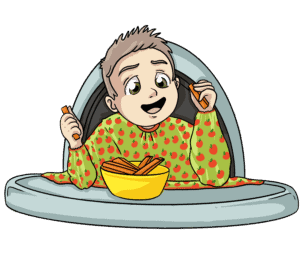
How to offer food to a baby safely?
Introducing risky foods to a baby can be scary. However, don't panic, there are several ways to safely introduce risky foods !
Discover the different ways to offer them to your little one.
Small, round, and hard foods
- Grapes, cherry tomatoes, candies, nuts, seeds from fruits and vegetables such as squash, watermelon, etc.
- The fruit: cut into quarters lengthwise
- Oilseeds: in puree, powder or in plant-based milks
- Seeds and sweets: do not give them
Raw and hard foods
- Apples, carrots, cucumbers, etc.
- Offer them to baby cooked and soft, grated, in smoothies, in compote, or in very thin slices
Flat and sticky foods
- Ham, crepes, salad, sliced bread, etc.
- Bread: toasted
- Salad, leafy greens, ham: to be given shredded or in a recipe
- Crepes: to be given shredded
Long foods
- Sausages, asparagus, beans, etc.
- Offer them to the baby cut into 4 lengthwise
- The vegetables: cooked and tender
Other small precautions will also need to be taken when offering certain foods to the baby.
- The skin, seeds, or pits of the fruit must be removed
- Crunchy fruits and vegetables will always be offered to baby cooked and soft
- The dried fruit will need to be rehydrated and incorporated into recipes
- The fish bones and meat bones will need to be removed
Foods to avoid in a baby's diet
Some foods should be avoided initially in a baby's diet because they pose a health risk . Some foods do n't have a sufficiently good nutritional profile to be offered to babies during meals. And others offer no nutritional value whatsoever for your little one.
Let each age enjoy the pleasure of discovery by offering babies foods following these recommendations:
Foods to avoid from a nutritional standpoint:
- Caffeinated beverages : not recommended for children under 12 years of age
Example: coffee, tea, energy drinks, cola, etc.
- Foods containing preservatives are not recommended for children under 3 years old. They can be served with a piece of fresh fruit rich in vitamin C, which neutralizes the negative effects of nitrites.
Example: industrial deli meats, commercially produced purees and yogurts, etc.
- Foods rich in phytoestrogens : not recommended before the age of 3
Example: tofu, soy juice, soy sauce, miso, etc.
- Foods containing contaminants : not recommended before the age of 3
Example: eel, carp, catfish, monkfish, sea bass, pike, sea bream, tuna , etc.
- Chocolate : forbidden before the age of 12 months and not recommended before the age of 3 years
- Foods and drinks with sweeteners (such as aspartame, etc.): prohibited before the age of 3.
Example: low-fat products, diet drinks, etc.
Foods to avoid from a nutritional point of view:
- Foods and drinks containing refined sugars recommended before the age of 3
Example: cakes, candies, biscuits, commercial ice cream, etc.
- Foods high in sodium ( salt : not recommended before the age of 3
Example: biscuits, crisps, commercial sauces, commercially available breaded fish and chicken, commercially available soups and bouillon cubes, industrially produced deli meats, etc.
- Ultra-processed foods high in unhealthy saturated fats : not recommended before the age of 3
Example: industrial deli meats, commercial fries and croquettes, commercial nuggets and breaded fish, etc.
- Low- fat foods : not recommended before the age of 3.
Example: yogurts containing less than 2% fat, skimmed milk, etc.
Foods to avoid from a microbiological point of view:
- Honey a food containing the Clostridium botulinum bacteria): prohibited before the age of 12 months
- Raw or undercooked meats before the age of 4
Example: tartare, carpaccio, etc.
- Raw cured meats: not before the age of 4
Example: sausage, raw ham, etc.
- Raw fish and shellfish : prohibited before the age of 4
Example: smoked salmon, sushi, ceviche, scallop carpaccio, raw oysters, etc.
- Raw or undercooked eggs in preparations: prohibited before the age of 4 .
Example: soft-boiled egg, medium-boiled egg, poached egg, unpasteurized mayonnaise or Caesar dressing, dessert mousse, etc.
- Raw milk and raw milk cheeses are prohibited before the age of 4. Raw milk cheeses can be added to a recipe if they are cooked thoroughly.
Example: Reblochon, Roquefort, Brie, etc.
Don't panic ! Keep this little reminder in mind and refer to it when planning your baby's weekly menu. Unsure about a safe format ? Find all the answers to your questions in our dedicated blog post!
2 answers