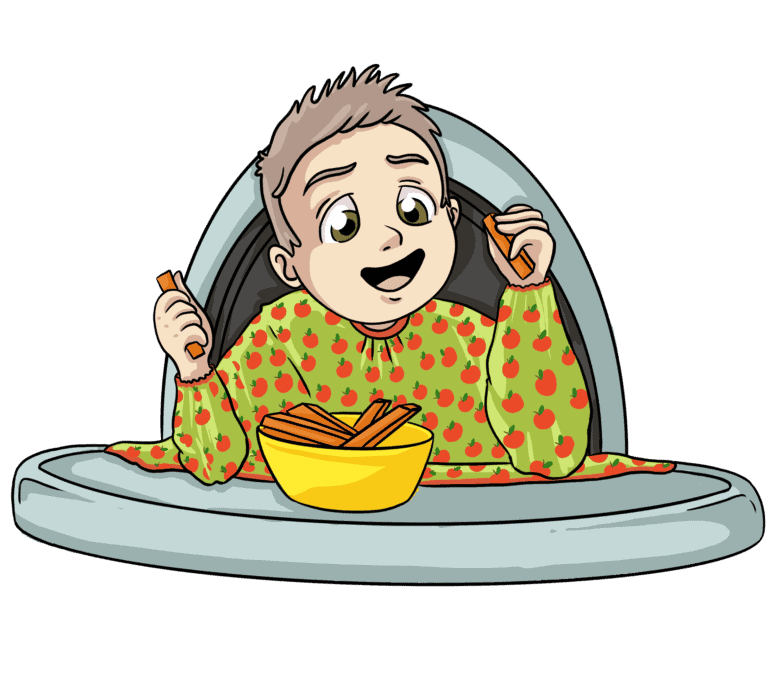
At the table, this desire to do well
Many parents feel pressure around baby's meals , especially when introducing solid foods.
When babies start eating solid foods, many parents feel an invisible pressure: the pressure to do things perfectly, at every meal.
Offer the right foods. The right texture . At the right time. In the right order.
Thus, without even realizing it, meals can become a space where we question, doubt, compare… when they are supposed to be a time of discovery.

Where does this pressure surrounding meals come from?
This pressure doesn't come from the baby.
In reality, it often comes from us.
Advice heard here and there.
Comparisons with other children.
Phrases like "he needs to eat" or "at that age, he should be..." .
In BLW , this mental burden can quickly take hold.
Every bite, every refusal, every gesture is observed, as if everything had to be perfectly controlled.
BLW is not a method to execute perfectly
Child-led weaning was never intended to ensure that everything went “well” at every meal.
It is based on simple principles:
to offer suitable foods,
to provide a safe and secure environment,
observe the baby,
and give it space to explore.
Babies learn by touching , squeezing, and putting things in their mouths… but also by rejecting, observing, and testing things in other ways.
These moments are an integral part of learning to eat.
Observe rather than control
Letting go at the table doesn't mean doing whatever you want.
It means changing your posture.
Moving from:
“Is he eating enough?”
has :
“What is he showing me today?”
Sometimes mealtimes are calm.
Others are more chaotic.
Some days, baby tastes with enthusiasm.
Other days, he mostly observes.
And all of this is normal.
How to let go in practice
Offer meals when the baby is rested
Eat at the same time as him
Avoid insistent encouragement (“come on, just one more bite”)
Accepting that some meals are primarily… observed
👉 Baby also learns when he doesn't eat.


Putting meals back in their proper place
Meals are important, but they should not become a source of daily tension.
When the atmosphere is relaxed, the baby feels this security.
And often, it is in this climate that discoveries are made best.
BLW adapts to real life, not a perfect setting.
Keep this in mind on the more difficult days
One meal does not define a day
One day does not define a week
One week does not define diversification
👉 It's the basics repeated over time that count.

In summary
In BLW , doing things well doesn't mean controlling everything.
On the contrary, it means proposing, observing, adjusting... and trusting.
These guidelines apply, of course, to a baby:
which follows its growth curve,
healthy,
and whose development is proceeding harmoniously.
If any doubt persists or if the baby presents a particular difficulty, medical advice is always recommended.
Letting go at the table, in a safe and suitable environment, isn't giving up.
It's about accompanying your baby with more serenity, for their sake as well as your own 💛