
Child-led weaning sometimes provokes reactions.
During a family meal or at a friend's house, certain phrases come up again and again:
“Does he eat solid food already?”
“Don’t you give him any puree?”
“He doesn’t eat much, does he?”
These remarks may seem innocuous.
Yet, they can create profound doubt.
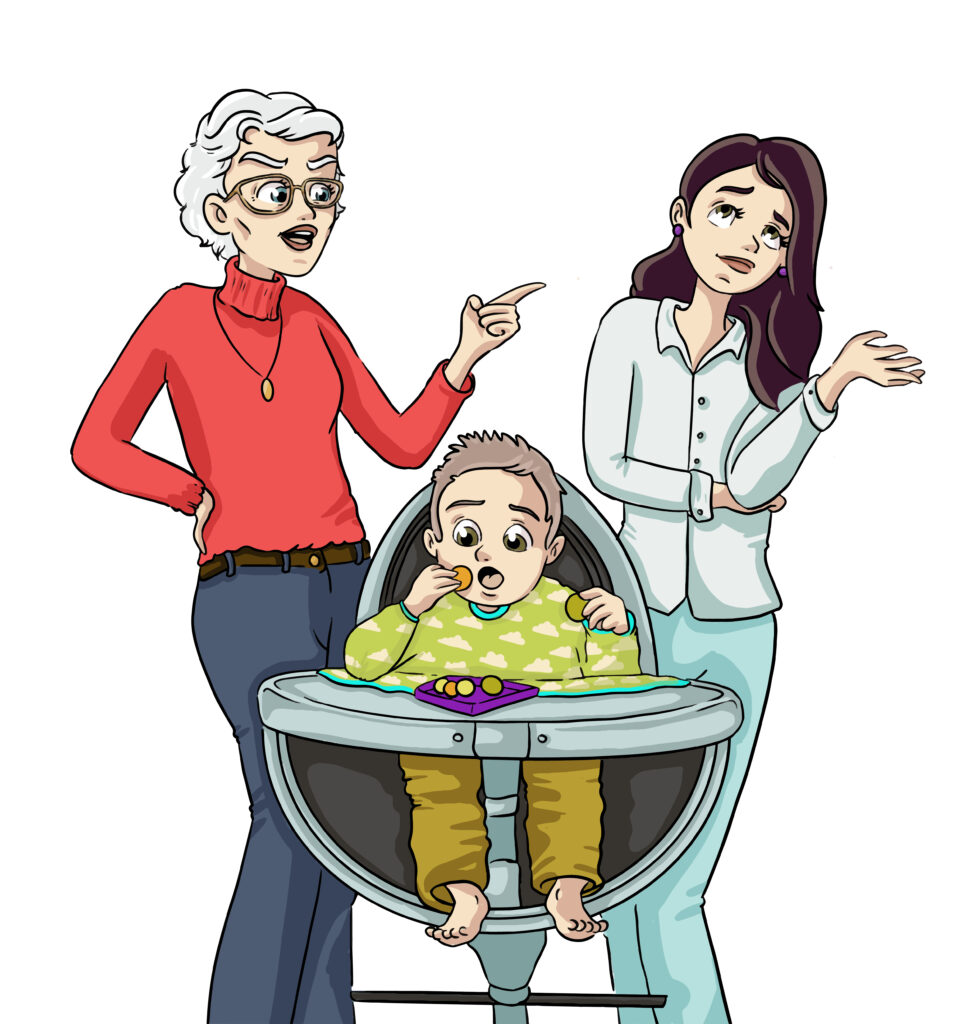
Why do these remarks affect us so much?
When you start BLW , you're still learning.
You observe, you adjust, you discover with the baby.
External comments sometimes undermine this confidence in the construction process.
Even if well-intentioned, these phrases can:
to sow doubt,
to compare,
to create unnecessary pressure.
Why BLW might be surprising
The BLW shakes things up.
It differs from what many previous generations have known.
It requires accepting that the baby explores, manipulates, and eats at its own pace.
To an outsider, this may seem unusual.
This discrepancy often explains the remarks.
How to stay aligned without entering into conflict
The goal is not to convince everyone.
It is possible to:
answer briefly and calmly
to explain if one wishes,
or simply smile and change the subject.
Trust remains the key.
If the baby is following its growth curve, is healthy and developing normally, there is no reason to doubt.
What really matters
In BLW , what builds success:
regularity,
observation,
trust,
time.
Outside opinions are welcome.
But they don't define your journey with your child.

How should one respond to remarks from those around them?
It's not always easy to find the right words in the moment.
Here are a few simple answers to help you stay calm and focused:
🟡 “Yes, it’s child-led weaning. He learns at his own pace.”
A short, factual answer, without excessive justification.
🟡 “His pediatrician is aware and everything is fine.”
This cuts short the debate without going into details.
🟡 “We’re testing another approach, and it suits us.”
State your choice without trying to convince anyone.
🟡 Smile… and change the subject.
You don't have to explain at every meal.

What to do when the remarks become insistent?
What to do when the remarks become insistent?
If the comments come up frequently, it may be helpful to:
Explain the BLW outside of mealtimes, at a calmer moment
Set a gentle boundary:
“I would prefer that we avoid this topic at the table.”
The goal is not to convince.
It is to preserve your peace of mind.
In summary
Comments from those around you are common in BLW .
They don't mean you're doing anything wrong.
Diversification is built over time, not through the approval of others.
Letting go also means accepting that not everyone will understand…
while remaining calm in your choices.