In BLW -Led Weaning), we will find three main stages that mark the baby's development. You will need to adapt the size, format, and texture of the pieces to meet the baby's changing needs and allow them to continue to develop and progress at their own pace.
The ages mentioned for each stage are guidelines only , as every baby is different and develops at their own pace. Your role? Observe your baby to continue meeting their needs!
Discovery phase (6 to 7 months)
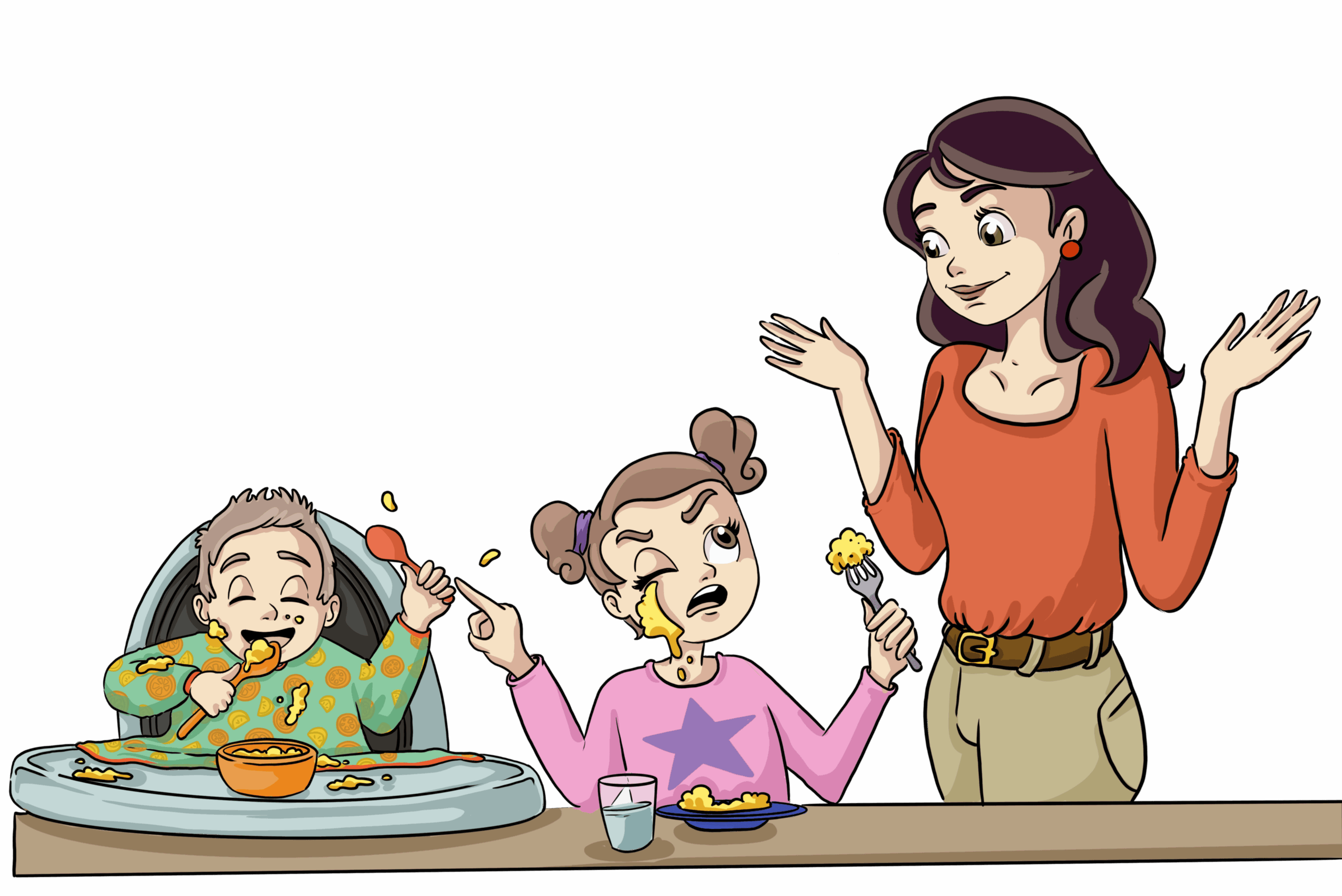
During this period, which usually lasts a month, the baby eats little or not at all (and that's normal!).
This is a period of food discovery . The focus is on stimulating the senses : offering meals with different colors, textures, shapes, and smells to attract and pique the baby's curiosity.
At first, the baby will observe, touch, and try to bring the food to their mouth. You might get the impression that they are playing more than eating. But don't worry, between 6 and 8 months, milk covers more than 80% of their energy needs . So, even if the baby eats little, or almost nothing, their energy needs will be met.
Every baby develops at their own pace. It's important to remember that BLW is a stage focused on independent food exploration . Food isn't weighed; simply ensure a variety of foods are offered, and let the baby choose what they need and in the appropriate quantities.
The size of the food
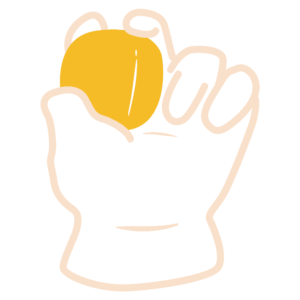
At 6 months, in terms of motor skills, a baby will only be able to open and close their fist. Therefore, you will need to adapt the size of the food to this size and offer foods that extend beyond their closed fist.
The ideal length is that of an adult's finger.

The diameter of the food
In this first phase, the diameter of the food is important and should be adapted to the baby's grasping ability .
If you offer sticks, they should be the diameter of an adult's finger, this will allow the baby to easily grasp them in their fist without them breaking.
If you are offering balls, they should be in the shape of a ping-pong ball.
The texture of food
During this phase, babies generally don't yet have teeth . Raw foods should be very ripe, and cooked foods should be very soft. When babies bring a piece of food to their mouth, they will flatten it between their tongue and palate .
How can you tell if a piece of meat is cooked enough?
Take the piece you just cooked, put it in your mouth between your tongue and your palate: if you can crush it against your palate, it is cooked properly.
Be careful not to overcook your sticks: these will need to be handled by the baby and if they are overcooked, they will crush directly in the baby's palm and quickly turn into a puree.
Mealtime atmosphere
The overall atmosphere at mealtimes is very important . Baby needs to be fully alert to be able to concentrate during their meal. If baby is tired, don't hesitate to postpone the meal until after their nap.
If your baby is very hungry , they may become frustrated trying to grab the food. In this case, start the meal by offering them their bottle of milk or breastfeeding first . They will then be able to eat their meal comfortably.
Some foods can have a slippery consistency. It will be difficult for a baby starting solids to grasp and put the food in their mouth without it slipping out of their hands. Here are some tips for adapting foods to your baby:
- Leave a piece of skin at one end so the baby can grab it
- Roll the food in coconut powder, almond powder, or oat flakes
- Pierce the food with a fork
- Spread the food onto a carrier
Development phase (7 to 9 months)
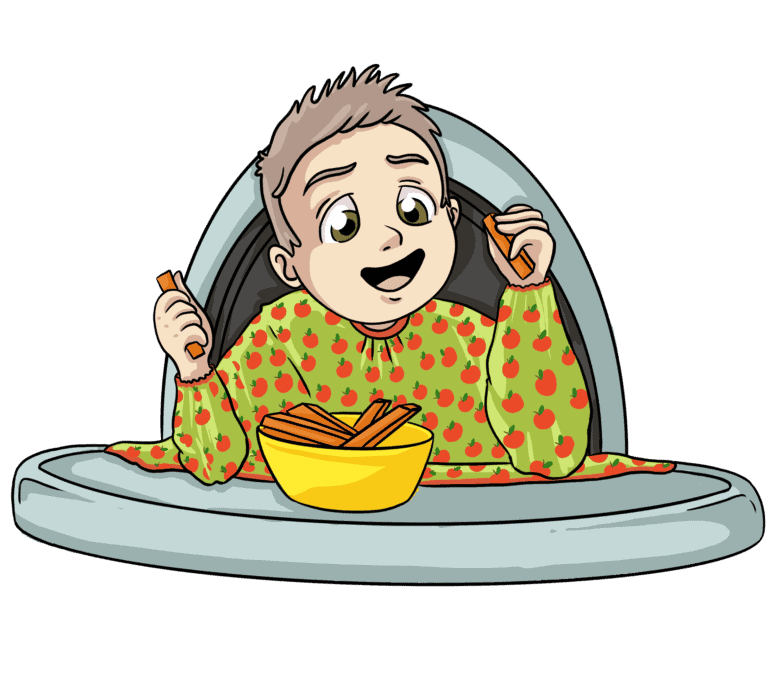
Baby's interest in food evolves gradually. Baby brings food to his mouth more and more easily and now knows how to grasp it with his three fingers (thumb, index, middle) even if he still lacks a little precision.
The meal goes more quickly and the baby is less tired at the end of the meal.
The size, diameter and texture of food
During the development phase, the textures remain melting or even crispy-melting (you bite into it and it melts directly in your mouth).
You can now reduce the size of the food and offer large cubes, wedges, slices, etc. Formats that are suitable for baby's grasping.
Refinement phase (9 to 12 months)
Baby can now use the pincer grasp (picking up food between their thumb and forefinger) and is mastering it more and more. Baby's chewing movements are becoming more repetitive, and we can therefore offer less soft textures . They will also enjoy eating their meals more and more.
introducing the fork now by spearing the food and the spoon by pre-filling it. You will let the baby bring the food to their mouth themselves .
We invite you to consult the article on the pre-filled spoon .

We can't stress this enough: every baby develops at their own pace . Therefore, advice and recommendations based on a baby's age should be taken with a grain of salt. Get down to your baby's level and adapt to their rhythm and development! An 8-month-old might be perfectly comfortable grasping a small piece, while another might only just be starting to manage a larger one. Remember that nobody likes to be frustrated, not even a baby! So, be sure to offer them pieces that are appropriate for them and let them develop at their own pace.
Pressure should not be part of baby-led weaning . It should remain a fun experience for both parent and baby.
As the days and months go by, your baby will change: Adapt to their development!
They won't eat soup the same way at 6 months as they will at 11 months. Initially, feed them with a pre-filled spoon; you can also try 360 cups, for example.
This will work for some and not for others, in any case never give up and try again a few days later.
Just like learning to walk, introducing solid foods will happen step by step!
6 answers