If the chosen fruit soft and melts in the mouth , it can be served raw.
If it is too hard (apple, peach, etc.), it should first be cooked to soften its texture.
The way fruit is presented will evolve as your baby's abilities develop. You'll need to adapt as you go and be able to recognize when the time is right to change things .
The Pear
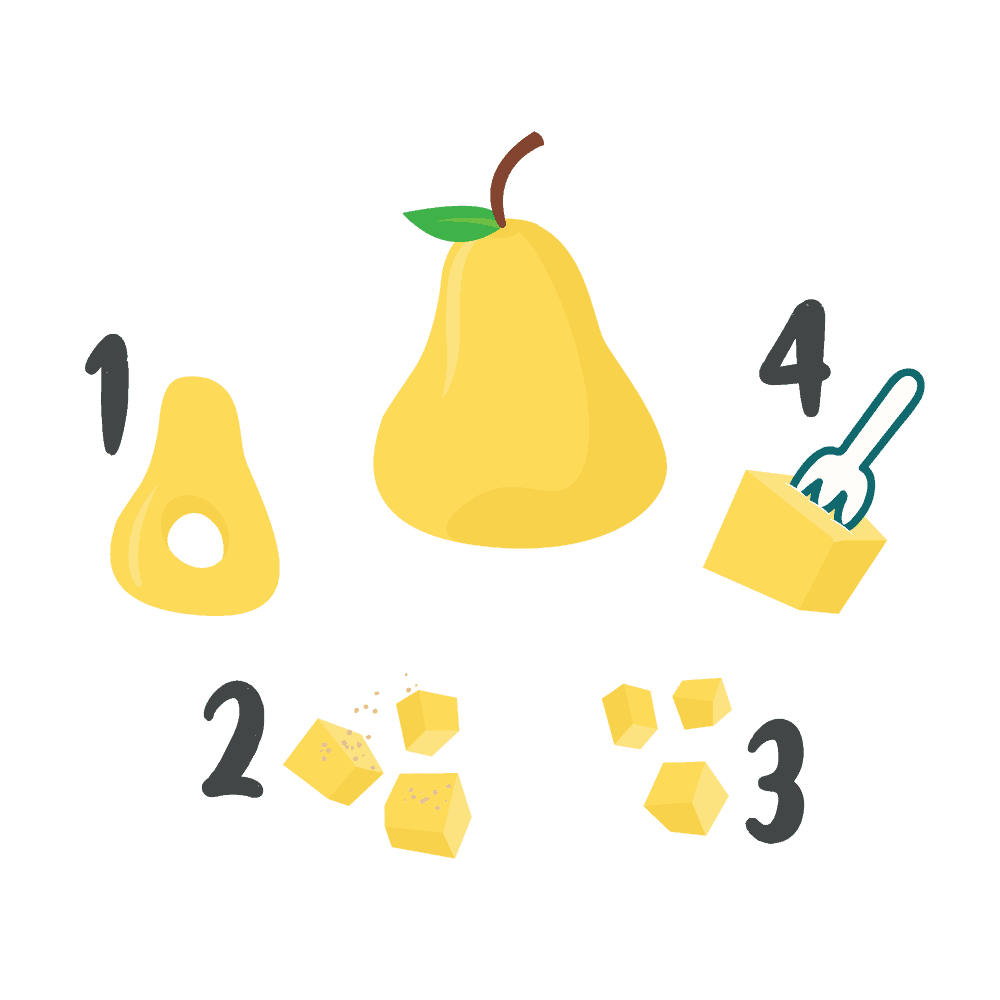
Initially, this product will be offered with a hole in the center . This will allow babies, from 6 months old, to easily grasp it . They will then be able to enjoy their fruit independently.
Between 7 and 9 months , babies bring food to their mouths more and more easily and can now grasp it with their three fingers (thumb, index, and middle), even if they still lack a little precision.
At this stage, we will offer small pieces of pear coated in coconut or almond powder , etc. This will allow babies to grasp them without the pieces slipping from their hands.
Once baby is perfectly comfortable with the tweezers , you can offer him the pieces without powder .
When baby is between 9 and 12 months old , and depending on his development (!), you can offer him pieces of pear directly on a fork.
Here is a table showing some examples of how to present fruit "as is ." Once your baby is comfortable with pieces and the discovery phase is over, feel free to introduce fruit into preparations such as pancakes , waffles , crepes , etc.
SOME EXAMPLES OF RAW FRUIT PRESENTATIONS
Apple
Discovery phase:
- Cooked in quarters
- Pre-filled spoon compote
Development phase:
- Raw grated
- Thin slices
Pear
Discovery phase:
- Well-ripened neighborhood with a hole
Development phase:
- Small pieces coated in almond powder, coconut
- Small pieces
Kiwi
Discovery phase:
- Quarter with notches for easier gripping
Development phase:
- Kiwi cubes
Banana
Discovery phase:
- Banana cut in half with peel on end
Development phase:
- Banana sticks
- Banana slices
Apricot
Discovery phase:
Cut in half without the pit
(Remember to remove the skin)
Development phase:
- Small pieces
Orange
Discovery phase:
- Orange supreme
Development phase:
- Small pieces
Grapes
Discovery phase:
- Cut in half and remove the seeds
Development phase:
- Cut into quarters and remove the seeds
Cherry
Discovery phase:
- Cut in half and remove the seeds
Development phase:
- Cut into quarters and remove the seeds
Khaki
Discovery phase:
Pre-filled spoon compote
Ripe pieces without skin
Development phase:
- Small pieces
Raspberry
Discovery phase:
Whole if they are large
Crushed onto a pre-filled spoon
Development phase:
- Cut in half
Strawberry
Discovery phase:
- Entire
Development phase:
- Small pieces
Melon
Discovery phase:
Sticks
Development phase:
- Small pieces
And what about dried fruit and nuts ? Click here to find out.
An answer