When you start introducing solid foods, many questions quickly arise.
Is the baby eating enough?
Am I offering the right foods?
Is everything going as it should?
In baby-led weaning ( BLW ), there is a very simple tool to reassure yourself and move forward calmly: observing your baby .
His gestures, reactions, and rhythm often convey far more information than one might imagine
In BLW , baby explores before eating
Contrary to what one might think, the first weeks of weaning are not focused on the quantity of food eaten.
Between 6 and 8 months , baby discovers above all:
textures
the smells
the shapes
the colors
the sensations in the hands
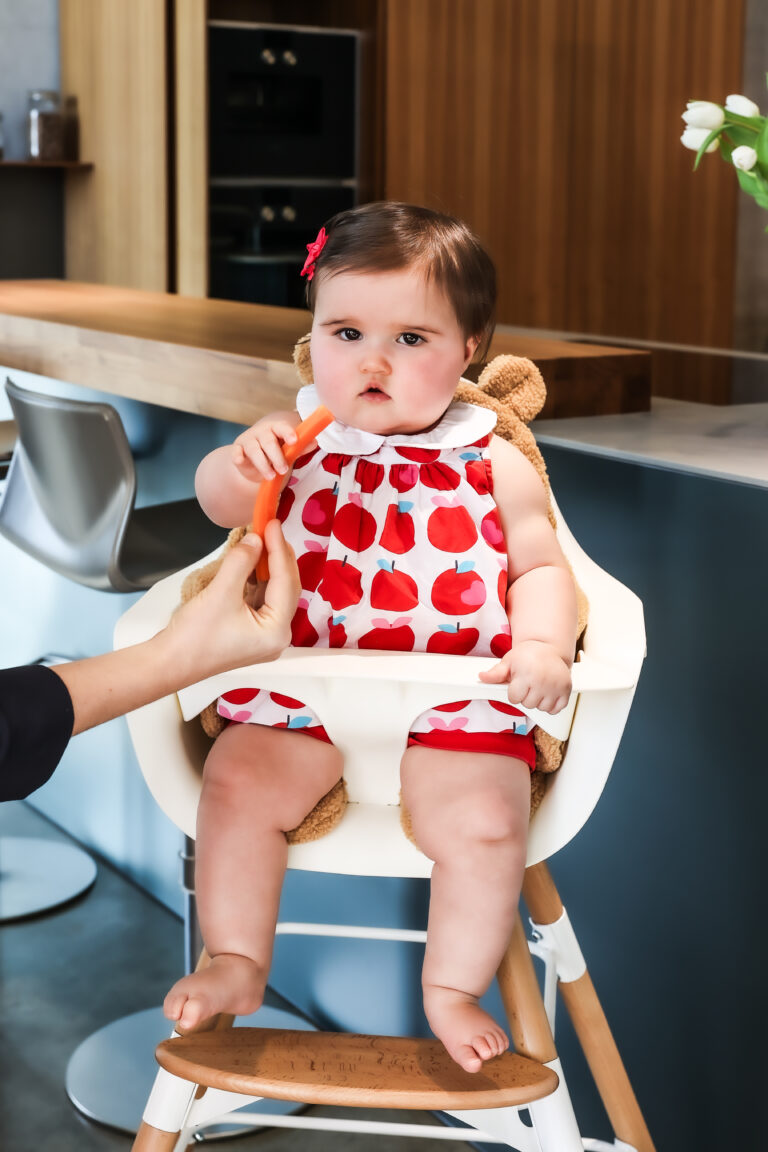
He can touch, crush, manipulate or simply observe the food on his plate.
And all of this is an integral part of learning about food .
Observing these moments allows parents to understand how baby gradually builds their relationship with food.
A baby's gestures tell a lot
Every baby reacts differently to food. By taking the time to observe them, it becomes easier to understand their preferences and discoveries.
For example :
A baby who looks at food for a long time often shows curiosity.
A baby who touches the same food several times is exploring its texture.
A baby who puts food in their mouth and then takes it away is simply testing a new sensation.
These actions are normal steps in learning about food .
BLW actually encourages this kind of natural exploration.
Baby's appetite can vary
Observation is also useful to understand that a baby's appetite is not constant.
Some days he can eat with great enthusiasm.
Other days he may eat very little.
Several factors can explain these variations:
fatigue
teething
a growth spurt
a more stimulating day than usual
Rather than focusing solely on the quantity eaten, it is often more relevant to observe the baby's overall condition .
If the baby is awake, active and following their growth curve, these variations are generally normal.

Observing the baby also helps to adapt meals
Through observation, parents can more easily adjust the meals offered.
For example :
offer a food item in a different format (stick, patty, muffin)
vary the textures
change the presentation on the plate
The same food can be rediscovered in many ways.
This variety stimulates baby's curiosity and makes mealtimes more attractive.

Trust is at the heart of BLW
Baby-led weaning is based on a simple idea: baby is an active participant in his or her food discoveries .
Parents offer food, create a safe environment, and guide exploration.
Baby, however, decides:
if he wants to taste
How much does he want to eat?
at what rate is he moving
Observing your baby then helps to strengthen this mutual trust.
Practical guide: what can be observed during meals?
During mealtimes, certain small signs can help you better understand your baby:
👀 His interest in food:
Does he look at the plate? Does he grab food easily?
✋ His way of handling food:
Does he crush it? Does he rub it? Does he put it in his mouth?
🙂 His taste reactions
: Does he grimace? Does he smile? Does he ask for more?
These observations simply allow you to support your baby without pressure or performance goals .
In summary
Observing your baby is one of the best indicators in baby-led weaning.
His gestures, reactions and rhythm allow us to understand how he discovers food and gradually builds his relationship with food.
Of course, these guidelines apply to a healthy baby who is following their growth curve and does not have any particular feeding difficulties .
With a little patience and a lot of observation, each meal then becomes an opportunity for learning and discovery .